Debt Snowball vs Debt Avalanche: Which Is Better?
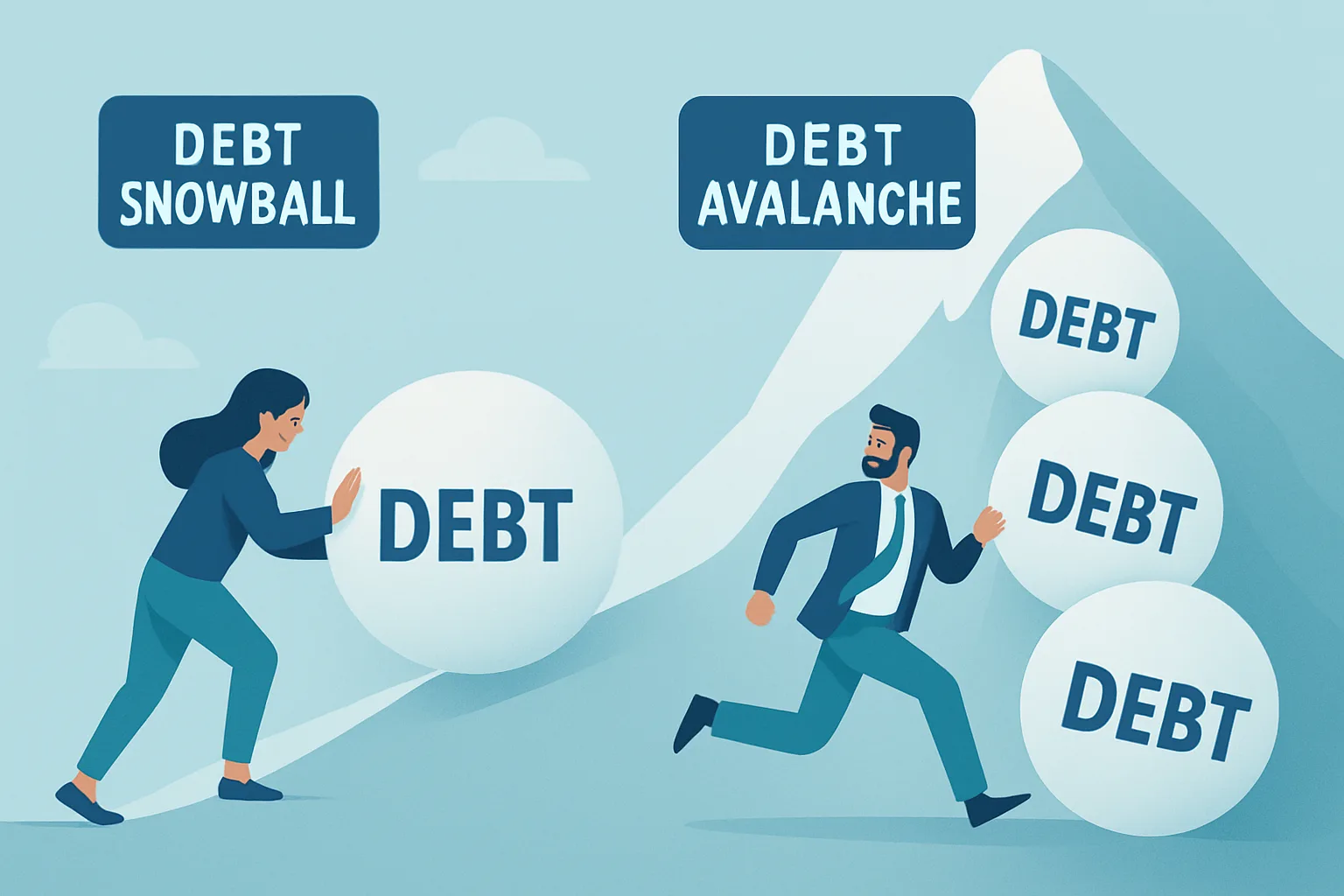
If you're carrying credit card balances, student loans, or other debts, you've probably heard of the debt snowball and debt avalanche methods. These are two popular strategies for paying off debt, but they work differently. Choosing the right one can make the difference between sticking with your plan or giving up. This article explains both methods in plain English, compares their pros and cons, and helps you decide which might work best for you.
Remember, this information is for educational purposes and does not constitute financial advice. Your personal situation may require a customized approach, so consider consulting a professional.
Whether you're looking for how to get out of debt or specifically how to pay off credit card debt, understanding these strategies is a great first step.
What Is the Debt Snowball Method?
The debt snowball method, popularized by personal finance expert Dave Ramsey, focuses on paying off your smallest debts first, regardless of interest rates. You list all your debts from smallest to largest balance. You make minimum payments on everything except the smallest debt, which you attack with any extra money you can scrape together. Once that debt is paid off, you roll the amount you were paying on it (the minimum plus any extra) into the next smallest debt. This creates a "snowball" effect: as each debt disappears, your available payment amount grows, accelerating your progress.
For example, suppose you have a $500 medical bill, a $2,000 credit card, and a $10,000 car loan. With the snowball method, you'd pay minimums on the credit card and car loan while putting every extra dollar toward the $500 bill. Once that's gone, you'd attack the credit card, then the car loan. The psychological boost from eliminating that first debt quickly can be powerful. Imagine seeing a zero balance on that $500 bill after just one month of focused effort; that feeling of accomplishment can fuel your determination to tackle the next debt. Over time, as you pay off each small balance, the momentum builds, and the "snowball" grows larger with each victory.
To illustrate in more depth, consider a scenario with five debts: a $300 utility bill, a $450 store card, a $1,200 personal loan, a $3,000 credit card, and a $15,000 student loan. With the snowball method, you would order them by balance: $300, $450, $1,200, $3,000, $15,000. You pay minimums on all but the $300 bill, putting any extra cash—say $200 per month—toward it. After about 1.5 months, that debt is gone. You then roll that $200 plus the minimum you were paying on the $300 bill (say $25) into the $450 store card, now paying $225 extra per month. That debt disappears in roughly 2 months. The pattern continues, and each time you eliminate a debt, the extra payment amount increases, making each subsequent debt get paid off faster. This method is less about math and more about behavior; it capitalizes on the human need for visible progress.
What Is the Debt Avalanche Method?
The debt avalanche method is mathematically optimized: you pay off debts in order of highest to lowest interest rate. You list your debts by APR, from highest to lowest. You make minimum payments on all debts except the one with the highest interest rate, which receives all your extra payments. Once that debt is gone, you move to the next highest rate, and so on. This approach minimizes the total interest you pay over time, potentially saving you hundreds or thousands of dollars.
Using the same example, if the credit card has a 22% APR, the car loan 6%, and the medical bill 0%, you'd focus on the credit card first, then the car loan, then the medical bill. The logic is straightforward: by eliminating the most expensive debt first, you stop the highest interest charges from accumulating. Over months and years, this can make a significant dent in your total repayment cost. For instance, if you have a $5,000 credit card at 24% APR and a $10,000 student loan at 5%, the credit card is costing you about $100 per month in interest alone, while the student loan costs about $42 per month. By paying off the credit card first, you save that $100 monthly interest, which can then be redirected to the student loan.
Let's expand with a more detailed example: suppose you have four debts—a $2,000 payday loan at 300% APR (a real but extreme case), a $4,000 credit card at 22%, a $6,000 personal loan at 10%, and a $20,000 car loan at 4%. With the avalanche method, you list them by rate: 300%, 22%, 10%, 4%. You pay minimums on all but the payday loan, which gets every extra dollar. Even though the payday loan might have a small balance, its astronomical interest rate means it's costing you roughly $500 per month in interest. Paying it off in a few months saves you hundreds of dollars compared to any other order. After that, you move to the credit card, then the personal loan, then the car loan. The avalanche method is coldly logical; it treats debt like a financial problem to be solved with maximum efficiency.
Key Differences Between Snowball and Avalanche
The fundamental difference is psychological vs. mathematical. The snowball method prioritizes quick wins by eliminating small balances first, which can provide motivation and momentum. The avalanche method prioritizes financial efficiency, saving more money on interest but possibly taking longer to see a debt fully paid off.
Here's a quick comparison:
| Factor | Debt Snowball | Debt Avalanche |
|---|---|---|
| Order of payoff | Smallest balance first | Highest interest rate first |
| Psychological benefit | High (quick wins) | Lower (first debt may take longer) |
| Total interest paid | Typically more | Minimized |
| Best for | People who need motivation | Disciplined, math-focused people |
Beyond this table, the differences extend to how each method affects your cash flow and emotional state. With the snowball method, you free up minimum payments from small debts quickly, which can give you a sense of financial breathing room. With the avalanche method, you might not free up any minimum payments for months, but you reduce the total cost of debt. Another key difference is the time to first payoff: snowball might give you a win in weeks, while avalanche could take months. This distinction is critical for people who struggle with delayed gratification. For example, someone with a $100 medical bill and a $5,000 credit card at 29% APR might pay off the medical bill in one month with snowball, feeling a rush of success. With avalanche, they'd target the credit card first, which could take 10 months or more to eliminate, testing their patience.
Pros and Cons of the Debt Snowball
Pros
- Motivation: Paying off a small debt quickly gives you a sense of accomplishment and encourages you to keep going.
- Simplicity: You don't need to track interest rates carefully; just focus on balances.
- Behavioral benefits: Many people find it easier to stick with a plan that shows fast results. The dopamine hit from each payoff reinforces the habit of paying down debt.
Cons
- Higher total interest: You may pay more interest overall because you're not targeting high-rate debts first. For example, if you have a $1,000 debt at 0% and a $2,000 debt at 25%, snowball would pay the 0% debt first, costing you extra interest on the high-rate debt.
- Slower progress on large debts: If your largest debts also have high interest, you could be paying them for a long time. This can be demoralizing if you're not seeing progress on the biggest balances.
To expand on the cons, consider a scenario where you have a $500 medical bill at 0%, a $1,000 credit card at 28%, and a $50,000 mortgage at 4%. With snowball, you'd pay the medical bill first, then the credit card, then the mortgage. But the credit card is costing you about $23 per month in interest, while the medical bill costs nothing. By delaying the credit card payoff, you might pay an extra $100 or more in interest over a few months. This is the trade-off: you gain motivation but lose money. For some, that loss is acceptable because the motivation keeps them from giving up entirely.
Pros and Cons of the Debt Avalanche
Pros
- Maximizes savings: You pay the least amount of interest over the life of your debts. For instance, if you have $10,000 in credit card debt at 22% and $5,000 in student loans at 5%, avalanche could save you $500 or more compared to snowball.
- Faster payoff in some cases: If high-interest debts are also large, you might eliminate them sooner than with snowball. This is because the avalanche method focuses on the most costly debts first, which can reduce the total time if those debts are large.
- Logical and efficient: It's the mathematically optimal approach. If you're a numbers person, this method appeals to your sense of reason.
Cons
- Can be demotivating: The first debt may take months or years to pay off, which can lead to discouragement. For example, if your highest-rate debt is a $15,000 credit card at 24%, it might take 18 months to pay off with extra payments, during which you see no zero balances.
- Requires discipline: You need to track interest rates and stick to the plan without quick wins. This can be challenging for people who thrive on immediate feedback.
To elaborate on the demotivation factor, imagine you have a $20,000 student loan at 6% and a $2,000 credit card at 25%. With avalanche, you attack the credit card first, which takes about 4 months with $500 extra per month. That's not too long, but if the credit card were $10,000, it could take 20 months. During that time, you might feel like you're not making progress on the student loan, even though you're saving money. This emotional toll can cause some people to abandon the plan altogether. On the other hand, disciplined individuals might find satisfaction in watching the interest savings grow, which serves as its own reward.
Which Method Saves More Money?
In almost every scenario, the debt avalanche method saves more money on interest. The exact amount depends on your balances, interest rates, and how much extra you can pay each month. For example, if you have $10,000 in credit card debt at 22% APR and a $5,000 personal loan at 8%, the avalanche method would save you hundreds of dollars compared to snowball. However, if the balances are similar and rates are close, the difference may be small.
But remember: saving money doesn't matter if you give up on the plan. The best method is the one you can stick with. Let's look at a more detailed comparison. Suppose you have three debts: Debt X: $3,000 at 18%, Debt Y: $4,000 at 12%, Debt Z: $2,000 at 6%. With snowball, you'd pay off Z first ($2,000 at 6%), then X ($3,000 at 18%), then Y ($4,000 at 12%). With avalanche, you'd pay off X first (18%), then Y (12%), then Z (6%). Using a debt calculator, assume you have $400 extra per month. Snowball might cost you about $1,200 in total interest over 30 months, while avalanche might cost $1,000 over 28 months. The $200 savings might not seem huge, but on larger debts, the gap widens. For instance, with $50,000 in total debt at varying rates, avalanche could save $2,000 or more. The key is to run the numbers for your specific situation.
Which Method Is More Motivating?
The debt snowball method is widely considered more motivating because it provides psychological wins early on. When you see a debt disappear, your brain releases dopamine, making you feel good and reinforcing the behavior. This can be crucial for people who struggle with consistency or have multiple debts. The avalanche method, on the other hand, may test your patience. If your highest-rate debt is also your largest, you might not see a zero balance for a long time.
That said, some people are motivated by numbers and logic. For them, watching the interest savings add up can be just as rewarding as checking off a small debt. For example, a person who enjoys tracking spreadsheets might find satisfaction in seeing the total interest paid decrease each month. They might feel a sense of control and efficiency that outweighs the lack of early wins. Additionally, the avalanche method can be motivating if you frame it as a challenge: "I'm going to beat the system by paying the least interest possible." Ultimately, motivation is personal, and you need to know what drives you.
How to Choose Between Snowball and Avalanche
Consider your personality and financial habits. Ask yourself:
- Do I need quick wins to stay motivated? If yes, snowball may be better.
- Am I disciplined enough to stick with a long-term plan without early rewards? If yes, avalanche might save you money.
- How large is the interest rate gap? If high-rate debts are much higher, avalanche is more beneficial.
- How many debts do I have? With many small debts, snowball can provide frequent wins.
You can also use a hybrid approach: pay off the smallest high-rate debt first, then switch to avalanche, or use a debt payoff calculator to compare outcomes. For instance, if you have a $500 debt at 20% and a $1,000 debt at 10%, you might pay the $500 debt first (which is both small and high-rate) and then switch to avalanche for the rest. This gives you a quick win while also targeting a high-rate debt. Another strategy is to use snowball for debts under a certain threshold (e.g., $1,000) and avalanche for larger debts. The goal is to create a plan that feels manageable and sustainable.
Real-World Examples: Snowball vs Avalanche
Let's look at two examples. Assume you have three debts: Debt A: $500 at 0% interest (medical bill), Debt B: $2,000 at 22% (credit card), Debt C: $10,000 at 6% (car loan). You have $500 extra each month.
Snowball
Pay $500 extra to Debt A. Paid off in 1 month. Then pay $500 extra to Debt B. That takes about 4 months (plus minimums). Then pay $500 extra to Debt C. Total interest: about $600 (illustrative). Time to debt-free: about 24 months.
Avalanche
Pay $500 extra to Debt B (highest rate). That takes about 4 months. Then pay $500 extra to Debt C. Then Debt A (0% interest) last. Total interest: about $400 (illustrative). Time to debt-free: about 23 months.
In this case, avalanche saves about $200 and finishes a month sooner. But if you had many small debts, the psychological boost from snowball might be worth the extra cost. Let's consider a second example with more debts: Debt D: $200 at 10%, Debt E: $800 at 15%, Debt F: $1,200 at 20%, Debt G: $5,000 at 8%, Debt H: $12,000 at 5%. With snowball, you'd pay off D ($200), then E ($800), then F ($1,200), then G ($5,000), then H ($12,000). With avalanche, you'd pay off F (20%), then E (15%), then D (10%), then G (8%), then H (5%). Assume $600 extra per month. Snowball might give you a win in the first month (Debt D), then another in about 1.5 months (Debt E), then another in 2 months (Debt F). That's three wins in under 5 months. Avalanche might take 2 months to pay off Debt F, then 1.5 months for Debt E, then less than a month for Debt D. The total time might be similar, but the snowball provides more frequent early victories, which can be crucial for maintaining momentum.
Can You Combine Both Methods?
Yes, you can customize your approach. For example, you might use the snowball method for your smallest debts (under $1,000) to get quick wins, then switch to avalanche for larger debts. Or you could target debts with both high interest and small balances first. The key is to create a plan that you can follow consistently.
If you're exploring options like balance transfer vs personal loan, these strategies can be applied to the new consolidated debt as well. For instance, if you consolidate multiple credit cards into a single personal loan with a lower interest rate, you can then apply either the snowball or avalanche method to that single debt (though it's just one debt, so the method becomes moot). Alternatively, if you have a mix of consolidated and non-consolidated debts, you can prioritize the one with the highest rate or smallest balance. Another hybrid approach is to use the "debt stacking" method, where you list debts by both balance and rate, and choose a customized order. For example, you might pay off a $300 debt at 10% before a $400 debt at 5%, even though the rate is higher on the $300 debt, because the balance is small. The flexibility of combining methods allows you to tailor the plan to your unique psychological and financial needs.
Common Mistakes When Using These Methods
Both methods require avoiding common pitfalls:
- Not having a budget: Without a budget, you won't know how much extra you can pay. A budget helps you identify areas where you can cut spending, such as dining out or subscriptions, to free up more money for debt repayment.
- Ignoring emergency fund: Paying off debt is important, but you need a small emergency fund (e.g., $1,000) to avoid new debt when unexpected expenses arise. Without this safety net, a car repair or medical bill could force you to use credit cards again, undoing your progress.
- Stopping minimum payments: Always pay at least the minimum on all debts to avoid fees and credit damage. Missing a minimum payment can lead to late fees, penalty interest rates, and a drop in your credit score.
- Not adjusting for life changes: If your income or expenses change, revisit your plan. For example, if you get a raise, consider increasing your extra payment amount. If you lose your job, you may need to pause extra payments and focus on minimums.
Another common mistake is comparing yourself to others. Someone might feel discouraged because their friend paid off debt faster using snowball, but their own situation has different balances and rates. Focus on your own progress. Also, avoid the temptation to "snowflake"—making small, random extra payments without a plan. While any extra payment helps, having a structured method ensures you're maximizing your efforts. Finally, don't neglect to celebrate milestones, even small ones. Acknowledging progress, like paying off 10% of your total debt, can boost morale.
The Role of Interest Rates in Your Decision
Interest rates are the single most important factor in the avalanche method, but they also play a role in the snowball method's effectiveness. When interest rates vary widely, the avalanche method's savings become more pronounced. For example, if you have a credit card at 29% APR and a student loan at 4%, the difference is stark. Paying the credit card first could save you hundreds of dollars per year in interest. On the other hand, if all your debts have similar interest rates (e.g., all between 10% and 15%), the snowball method might cost you only a small amount extra, making the psychological benefits more attractive.
Consider a scenario with three debts: a $1,000 debt at 12%, a $2,000 debt at 13%, and a $3,000 debt at 11%. The rates are close, so the avalanche method would target the $2,000 debt first (13%), then the $1,000 debt (12%), then the $3,000 debt (11%). The snowball method would target the $1,000 debt first, then $2,000, then $3,000. Using a calculator, the difference in total interest might be only $50 over the life of the debts. In this case, the snowball method's quick win (paying off $1,000 in a few months) might be worth the $50 cost. However, if the rates were 29%, 12%, and 6%, the difference could be $500 or more, making avalanche the clear winner financially. So, when rates are close, prioritize psychology; when rates are far apart, prioritize math.
How to Track Your Progress Effectively
Tracking your progress is essential for staying motivated and ensuring you're on track. You can use a simple spreadsheet, a debt tracking app, or even a paper chart. List each debt with its balance, interest rate, minimum payment, and target payoff date. Update the balances monthly. For the snowball method, you might color-code debts as you pay them off, creating a visual representation of your progress. For the avalanche method, you could track the total interest saved each month, which can be motivating for math-oriented people.
Another effective technique is to create a "debt payoff thermometer" that shows your total debt decreasing over time. This visual can be placed on your refrigerator or in a journal. Additionally, consider setting mini-goals, such as paying off 25% of your total debt or reaching a certain net worth milestone. Celebrate these achievements with a small, non-financial reward, like a movie night or a hike. Tracking also helps you catch mistakes early, such as missing a payment or underestimating interest charges. Finally, review your progress monthly to see if you need to adjust your strategy. For example, if you get a windfall like a tax refund, you might decide to apply it to a specific debt based on your method.
When to Consider Professional Help
If your debt feels overwhelming, or if you're struggling to make minimum payments, you may benefit from credit counseling or debt management programs. A nonprofit credit counselor can help you create a budget and may negotiate lower interest rates with creditors. In some cases, debt settlement or bankruptcy might be options, but these have serious consequences. Always research and choose reputable organizations.
Professional help is especially valuable if you have multiple high-interest debts and are considering consolidation. A counselor can explain the pros and cons of options like debt management plans, which consolidate payments into one monthly amount, often with reduced interest rates. They can also help you decide whether the snowball or avalanche method is more appropriate given your financial habits. Remember, this article provides general information, not financial advice. Your situation is unique, so consider consulting a professional. If you're unsure where to start, look for agencies affiliated with the National Foundation for Credit Counseling (NFCC) or the Financial Counseling Association of America (FCAA).
Key takeaways
- The debt snowball method pays off smallest balances first for psychological motivation; the debt avalanche method pays off highest interest rates first to save money.
- Snowball is better for people who need quick wins; avalanche is better for those who can stick with a mathematically optimal plan.
- Neither method is universally superior—the best one is the one you can follow consistently.
- Use a calculator to compare outcomes for your specific debts before choosing.
- Always maintain minimum payments and a small emergency fund while paying off debt.
Frequently asked questions
Which is better for beginners: debt snowball or avalanche?
Does the debt avalanche method really save that much money?
Can I switch from snowball to avalanche halfway through?
What if all my debts have similar interest rates?
Should I include my mortgage in a debt snowball or avalanche plan?
This article is for general informational purposes only and does not constitute financial, legal or credit-repair advice. Always consult a qualified financial advisor or credit counselor about your specific circumstances.

Written & reviewed by
Can OTUEditor
Can OTU is the editor of this site, curating and reviewing every guide for accuracy and clarity.
View all guides →