Balance Transfer vs Personal Loan to Pay Off Debt
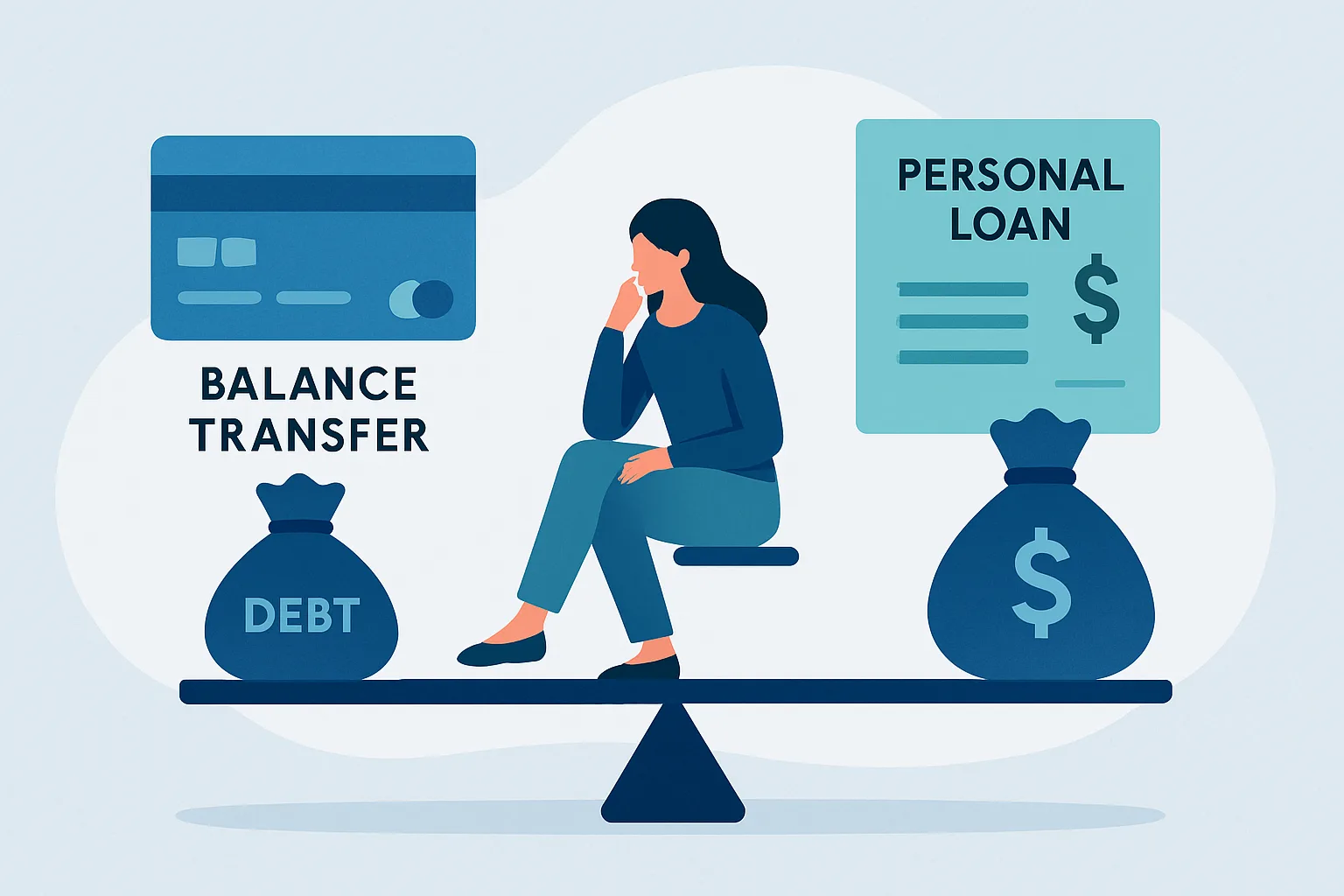
If you're carrying credit card debt with high interest rates, you've probably come across two popular options: a balance transfer credit card or a personal loan. Both can help you consolidate debt and save money on interest, but they work very differently. Choosing the right one depends on your credit score, the amount of debt you have, and how quickly you can pay it off.
This article explains the key differences between a balance transfer and a personal loan, including how they affect your credit, what they cost, and which situations each one is best for. We'll also walk through step-by-step instructions for using each method effectively. Remember, this is general information for educational purposes and not financial advice.
Whether you're looking for how to pay off credit card debt or exploring strategies like debt snowball vs avalanche, understanding the tools available is the first step toward financial freedom.
What Is a Balance Transfer?
A balance transfer involves moving your existing credit card debt from one or more cards to a new credit card that offers a low or 0% introductory annual percentage rate (APR) for a set period, typically 12 to 21 months. During the promotional period, you pay no interest on the transferred balance, which allows your payments to go entirely toward reducing the principal debt. For example, imagine you have $8,000 spread across two credit cards, one charging 22% APR and another charging 19% APR. By transferring both balances to a single card with a 0% intro APR for 18 months, you stop all interest accrual on that $8,000 immediately. Every dollar you pay each month goes directly to shrinking the principal, which accelerates your debt payoff timeline significantly.
Balance transfers are usually offered by credit card companies to attract new customers. Most charge a balance transfer fee, typically 3% to 5% of the amount transferred. For example, transferring $10,000 with a 3% fee costs $300. That's a one-time cost, and if you pay off the balance within the promotional window, you can save significantly compared to paying 18% or more in interest. To put this in perspective, if you kept that $10,000 on a card with 20% APR and paid $600 per month, you would pay roughly $1,800 in interest over 18 months. With the balance transfer, you pay just the $300 fee and no interest, saving about $1,500.
However, once the promotional period ends, the remaining balance will start accruing interest at the card's regular APR, which can be high. Also, balance transfers are generally limited to credit card debt; you usually cannot use them to pay off other types of loans like auto loans or student loans. Some issuers allow transfers to bank accounts, but that is less common and may carry additional restrictions.
What Is a Personal Loan for Debt Consolidation?
A personal loan is an installment loan from a bank, credit union, or online lender. You receive a lump sum of money, which you can use to pay off your credit cards or other debts. Then you repay the loan in fixed monthly installments over a set term, usually 2 to 5 years. Personal loans typically have fixed interest rates, meaning your monthly payment stays the same throughout the loan term. For instance, if you borrow $15,000 at a fixed rate of 9% for three years, your monthly payment would be approximately $477, and you would know exactly how much to budget each month until the loan is fully repaid.
Interest rates on personal loans vary widely based on your creditworthiness. Borrowers with excellent credit might qualify for rates as low as 6% to 8%, while those with fair or poor credit could see rates of 20% or higher. Unlike balance transfers, personal loans often have no introductory teaser rates; the rate you're approved for is the rate you pay from day one. This predictability can be a major advantage for people who prefer stable, unchanging payments and want to avoid the shock of a rate increase after a promotional period ends.
Personal loans can be used for almost any purpose, including consolidating credit card debt, medical bills, or other high-interest loans. They also have an origination fee in some cases, typically 1% to 8% of the loan amount, which is deducted from the loan proceeds or added to the balance. For example, a $10,000 loan with a 5% origination fee would yield only $9,500 in your bank account, but you would still owe the full $10,000 plus interest. Some lenders offer no-fee loans, so it pays to shop around.
Key Differences Between Balance Transfer and Personal Loan
Understanding the core differences helps you decide which tool fits your situation. Here's a comparison of the most important factors:
| Feature | Balance Transfer | Personal Loan |
|---|---|---|
| Interest rate | 0% intro APR for 12-21 months, then high regular APR | Fixed rate from day one (typically 6%–36%) |
| Fees | Transfer fee 3%–5% | Origination fee 0%–8% (some lenders charge none) |
| Repayment term | No fixed term; must pay before promo ends | Fixed term (2–5 years) |
| Monthly payment | Varies; you decide how much to pay | Fixed amount each month |
| Credit impact | Hard inquiry; new account lowers average age; utilization may improve | Hard inquiry; mix of credit improves; utilization may improve |
| Debt types | Credit card debt only | Any debt (credit cards, medical, etc.) |
Beyond this table, it's important to consider that balance transfers require you to be disciplined about making payments above the minimum. With a personal loan, the fixed payment structure forces you to pay a set amount each month, which can be easier for people who struggle with variable payments. However, the flexibility of a balance transfer can be an advantage if you have irregular income and want to pay more in some months and less in others, as long as you clear the balance before the promo ends.
How Credit Scores Affect Your Options
Your credit score plays a major role in determining which option is available to you and at what cost. For balance transfers, you typically need good to excellent credit (a FICO score of 670 or higher) to qualify for the best 0% APR offers. If your credit is fair or poor, you may not qualify at all, or you might only get a card with a short promotional period and a high regular APR. For instance, someone with a score of 650 might be offered a card with only 12 months of 0% APR and a 5% transfer fee, while someone with a 750 score could get 21 months at 0% with a 3% fee. The difference in terms can be worth thousands of dollars in potential savings.
Personal loans are more accessible to a wider range of credit scores. Many lenders offer loans to borrowers with scores as low as 580, though the interest rates will be higher. Having a co-signer can also help you qualify for a better rate. If you're working on how to raise your credit score fast, you may want to delay applying until your score improves enough to get favorable terms. For example, raising your score from 620 to 680 could drop your personal loan rate from 25% to 12%, saving hundreds of dollars per year in interest.
Both options involve a hard credit inquiry, which can temporarily lower your score by a few points. However, the long-term effect of paying down debt is usually positive. When you reduce your credit utilization by paying off credit cards with a personal loan, your score often rebounds within a few months. Similarly, a balance transfer that lowers your utilization can boost your score, provided you don't close the old accounts.
Cost Comparison: Which Saves You More Money?
The total cost of each option depends on the interest rates, fees, and how quickly you repay the debt. Let's illustrate with an example. Suppose you have $10,000 in credit card debt at an average APR of 20%.
Balance Transfer Scenario
You get a balance transfer card with a 0% intro APR for 18 months and a 3% transfer fee ($300). If you pay off the full $10,000 within 18 months, you pay only the $300 fee. If you take the full 18 months, your monthly payment would be about $572 ($10,300 / 18). Compare that to paying the same amount on your original card: at 20% APR, you'd pay over $1,600 in interest over 18 months, plus the principal. So the balance transfer saves you about $1,300. But consider a more aggressive payoff: if you pay $700 per month, you would clear the debt in about 15 months and pay only the $300 fee, saving even more compared to the credit card's interest.
But if you don't pay off the balance before the promo ends, the remaining balance will start accruing interest at the card's regular APR (say 24%). If you still owe $5,000 after 18 months, you'll pay interest on that at a high rate, potentially wiping out your savings. For instance, if you take another 12 months to pay off that $5,000 at 24% APR, you would add roughly $670 in interest, making your total cost $970 ($300 fee + $670 interest), which is still less than the original card's interest but far more than the $300 fee alone.
Personal Loan Scenario
You take a personal loan for $10,000 at a fixed APR of 10% (assuming good credit) with a 3-year term and no origination fee. Your monthly payment would be about $323, and total interest paid would be about $1,616. That's higher than the balance transfer fee but lower than keeping the debt on credit cards. If your credit is only fair, a rate of 20% would mean monthly payments of about $372 and total interest of $3,388. In this case, the personal loan is still cheaper than the credit card's 20% APR if you were making minimum payments, but it's more expensive than the balance transfer if you can pay off within 18 months.
In general, a balance transfer is cheaper if you can pay off the debt quickly (within the promo period). A personal loan is better if you need a longer repayment term or want predictable payments. For someone with $25,000 in debt who can only afford $500 per month, a personal loan with a 5-year term might be the only viable option, even though the total interest will be higher than a balance transfer fee.
Repayment Discipline: The Hidden Factor
Both tools require discipline to be effective. With a balance transfer, you must make regular payments and avoid adding new purchases to the card (which often have a different APR and can complicate payoff). Many people treat the card as a new credit line and end up in more debt. For example, someone transfers $8,000 to a 0% card, then charges $2,000 in new purchases on the same card. Now they have $10,000 in total balance, with the new purchases accruing interest at the regular APR from day one. This defeats the purpose of the transfer and can lead to a debt spiral.
With a personal loan, you have fixed payments, which can help you budget. However, there's a risk of running up credit card balances again after paying them off, leaving you with both a loan and new card debt. To avoid this, consider closing or not using the paid-off cards until the loan is repaid. A practical approach is to freeze the cards in a block of ice or store them in a safe deposit box, making it harder to use them impulsively.
Choosing a repayment strategy like how to get out of credit card debt often involves behavioral changes. The debt snowball or avalanche methods can be applied whether you use a balance transfer or personal loan. The snowball method focuses on paying off the smallest balance first for psychological wins, while the avalanche method targets the highest interest rate first to save the most money. Both can be combined with consolidation to streamline payments and reduce stress.
Impact on Credit Score
Both options affect your credit in similar ways initially: a hard inquiry and a new account. Over time, the impact depends on how you manage the debt.
Balance Transfer Credit Impact
Opening a new credit card increases your total available credit, which can lower your credit utilization ratio (the amount of credit you're using divided by your total credit limits). This is good for your score. For example, if you had $10,000 in debt on a card with a $12,000 limit (83% utilization), and you transfer it to a new card with a $15,000 limit, your utilization on the new card is 67% (assuming you don't close the old card). If you keep the old card open with a zero balance, your overall utilization drops even further, potentially boosting your score by 20-30 points. However, the new account lowers your average age of accounts, which can hurt your score slightly if you have a short credit history. Also, if you close the old cards after transferring, you lose their credit limits, which could increase utilization and lower your score.
Personal Loan Credit Impact
A personal loan adds an installment loan to your credit mix, which can benefit your score if you don't have many installment accounts. It also reduces your credit card utilization because you pay off the cards, which is a positive. However, the loan balance counts as debt, and high balances relative to the loan amount can hurt your score. As you make on-time payments, your score should improve. For instance, if you take a $10,000 loan and pay it down to $5,000 over 18 months, your credit score may rise due to the reduced debt load and the positive payment history.
In both cases, missing payments will damage your score significantly. Set up automatic payments or reminders to stay on track. A single late payment can drop your score by 60-100 points, depending on your credit history, and can stay on your report for seven years.
When to Choose a Balance Transfer
A balance transfer is a good option if:
- You have good to excellent credit (670+).
- You can pay off the entire transferred balance within the promotional period (usually 12-21 months).
- You have a manageable amount of debt (typically under $15,000, as cards have credit limits).
- You are confident you won't rack up new charges on the card.
- You want to avoid interest entirely while paying down debt.
Balance transfers are less suitable if you need more than 2 years to repay, have poor credit, or have debt that isn't credit card debt. For example, if you have $20,000 in credit card debt and can only afford $500 per month, a balance transfer won't work because you'd need 40 months to pay it off, far exceeding any promo period. In that case, a personal loan or debt management plan might be better.
When to Choose a Personal Loan
A personal loan is a better fit if:
- You have fair to good credit (580+).
- You need a longer repayment term (2-5 years) to keep payments affordable.
- You want fixed monthly payments for easier budgeting.
- You have multiple types of debt (credit cards, medical bills, etc.) to consolidate.
- You have a large debt amount that exceeds typical credit card limits.
Personal loans are less ideal if you can pay off debt quickly (within a year), as the interest costs may exceed a balance transfer fee. For instance, if you have $5,000 in debt and can pay $500 per month, you'd clear it in 10 months. A balance transfer with a 3% fee ($150) would be cheaper than a personal loan with a 10% APR (about $250 in interest over 10 months).
How to Apply for a Balance Transfer
Follow these steps to use a balance transfer effectively:
- Check your credit score. Make sure it's high enough to qualify for a card with a 0% intro APR and low fees. Use a free service like Credit Karma or your bank's app to get your score.
- Compare offers. Look at the length of the intro period, the transfer fee, and the regular APR after the promo ends. Use online comparison tools like NerdWallet or Bankrate. Pay attention to any caps on the transfer amount or fees.
- Apply for the card. Submit an application. If approved, you'll receive a credit limit. Only transfer an amount up to that limit. For example, if your limit is $12,000 and you have $15,000 in debt, you can only transfer $12,000.
- Initiate the transfer. Provide the details of the cards you want to pay off. The new card issuer will send payments to those creditors. This can take a few weeks, so continue making minimum payments on your old cards until the transfer is complete to avoid late fees.
- Create a payoff plan. Divide the total amount (including fees) by the number of months in the intro period to determine your minimum monthly payment needed to avoid interest. For example, $10,300 / 18 = $572 per month. If you can pay more, do so to create a buffer.
- Stop using the old cards. Cut them up or lock them away to avoid temptation. Consider removing them from online wallets like Apple Pay or PayPal.
- Set up autopay. Ensure you never miss a payment, as late payments may void the intro rate. Most issuers require at least the minimum payment each month.
How to Apply for a Personal Loan
Here's a step-by-step guide for getting a personal loan for debt consolidation:
- Check your credit score. Know your score and review your credit report for errors. If your score is low, consider improving it before applying. You can get free reports at AnnualCreditReport.com.
- Prequalify with multiple lenders. Many lenders offer prequalification with a soft credit check, which doesn't affect your score. Compare rates, fees, and terms from banks like Wells Fargo, credit unions like Navy Federal, and online lenders like SoFi or LightStream.
- Choose a loan amount and term. The amount should cover your total debt plus any origination fees. Choose the shortest term you can afford to minimize interest. For example, a 3-year term for $10,000 at 10% costs $1,616 in interest, while a 5-year term costs $2,748 in interest.
- Submit a formal application. Provide income and employment information. The lender will do a hard credit check, which may temporarily lower your score by a few points.
- Review the loan offer. Check the APR, monthly payment, and total cost. Accept only if it improves your situation. If the rate is higher than your current credit card rates, reconsider.
- Funds are disbursed. Typically within a few business days. Use the money to pay off your credit cards immediately. Don't spend it on anything else.
- Make on-time payments. Set up autopay to avoid late fees and credit damage. Consider paying extra when possible to reduce the principal faster.
Common Mistakes to Avoid
Both strategies have pitfalls. Here are the most common mistakes:
- Not reading the fine print. Balance transfer cards may have conditions like requiring minimum payments or charging interest on new purchases. Personal loans may have prepayment penalties (rare but possible). Always read the terms carefully.
- Using the freed-up credit. After paying off credit cards, the available credit can tempt you to spend again. This leads to more debt. For example, someone pays off $8,000 in cards with a personal loan, then charges $5,000 on the same cards within six months. Now they have $13,000 in total debt.
- Choosing a longer term than needed. With personal loans, a longer term means lower monthly payments but more total interest. Pay it off as fast as you can. A 5-year loan at 10% on $10,000 costs $2,748 in interest, while a 2-year loan costs $1,074.
- Ignoring fees. A 5% balance transfer fee on a large debt can be substantial. Compare it to the interest you'd pay otherwise. For $20,000, a 5% fee is $1,000, which might be worth it if you can pay off in 12 months and avoid $3,000 in interest.
- Applying for too many cards or loans. Multiple hard inquiries in a short time can hurt your credit score. Space out applications. Some credit scoring models treat multiple inquiries for the same type of loan within a 14-45 day window as a single inquiry, but it's still risky.
Alternatives to Balance Transfers and Personal Loans
If you don't qualify for either option, or if they don't suit your needs, consider these alternatives:
- Debt management plan (DMP). A nonprofit credit counseling agency negotiates lower interest rates with your creditors and sets up a single monthly payment. You pay a small fee, but it can reduce your interest significantly. For example, a DMP might lower your credit card APR from 22% to 8%, allowing you to pay off debt faster. Agencies like NFCC or GreenPath offer these services.
- Home equity loan or HELOC. If you own a home, you can borrow against your equity at lower rates. But your home is collateral, so defaulting puts it at risk. For instance, a $30,000 home equity loan at 6% for 10 years would have payments of about $333 per month, but if you miss payments, you could lose your house.
- Debt settlement. You stop paying creditors and negotiate a lump-sum payment for less than you owe. This damages your credit and may have tax consequences. For example, settling $20,000 in debt for $10,000 might seem good, but the forgiven $10,000 is considered taxable income by the IRS.
- Balance transfer with a 0% intro APR for purchases. Some cards offer 0% on purchases for a period, which can help if you need to make a large purchase, but it's not ideal for existing debt. This is better for planned expenses like a new appliance, not for consolidating old debt.
How to Choose Between a Balance Transfer and Personal Loan: A Decision Framework
To make the best choice, consider your specific financial situation using this framework. First, calculate your total debt and your monthly payment capacity. If you have $8,000 in credit card debt and can pay $600 per month, you can clear it in about 13 months. A balance transfer with an 18-month promo period would work perfectly, saving you hundreds in interest. But if you have $25,000 in debt and can only pay $500 per month, you need 50 months to pay it off, making a personal loan with a 5-year term the only realistic option.
Second, evaluate your credit score. If your score is above 700, you have access to the best balance transfer offers and personal loan rates. If your score is between 580 and 669, you may still qualify for a personal loan but at higher rates, while balance transfer offers will be limited or unavailable. In that case, focus on improving your score first or consider a co-signer.
Third, consider the type of debt. If you have only credit card debt, a balance transfer is a strong contender. If you have a mix of credit card debt, medical bills, and a personal loan from a friend, a personal loan allows you to consolidate everything into one payment. For example, consolidating $5,000 in credit card debt, $3,000 in medical bills, and $2,000 in a store card into one $10,000 personal loan simplifies your finances and can lower your overall interest rate.
Fourth, think about your spending habits. If you tend to use credit cards impulsively, a personal loan might be safer because you close the credit card accounts (or stop using them) and have a fixed payment. If you are disciplined and can avoid new charges, a balance transfer can be more cost-effective.
Finally, run the numbers using online calculators. Compare the total cost of a balance transfer (fee plus any interest after the promo) versus a personal loan (interest over the full term). Include any fees and consider different payoff speeds. This concrete comparison will reveal which option saves you the most money in your unique situation.
The Role of Emergency Funds in Debt Consolidation
An often-overlooked factor in choosing between a balance transfer and a personal loan is the need for an emergency fund. When you consolidate debt, you free up monthly cash flow, but you also reduce your available credit. If you use a balance transfer, your old credit cards may have zero balances, but you could still use them in an emergency, though that risks adding new debt. With a personal loan, you pay off the cards, and their credit limits remain available, but you have a new fixed payment that reduces your monthly disposable income.
Ideally, you should have at least $1,000 in savings before starting any debt payoff plan. This prevents you from needing to borrow more when unexpected expenses arise, like a car repair or medical bill. If you don't have an emergency fund, consider a personal loan that allows you to borrow a little extra (e.g., $11,000 instead of $10,000) to create a small cash buffer, but only if you are confident you won't spend it frivolously. Alternatively, you could delay consolidation for a month or two to build up a small savings cushion.
Without an emergency fund, you might be forced to use credit cards again after consolidation, undermining your progress. For example, you consolidate $10,000 in debt with a personal loan, then your car needs a $2,000 repair. If you have no savings, you might put it on a credit card, adding new high-interest debt on top of your loan. This is why financial experts recommend building a small emergency fund before aggressively paying off debt.
Key takeaways
- Balance transfers offer 0% interest for a limited time but require good credit and quick repayment to be effective.
- Personal loans provide fixed payments and longer terms, making them suitable for larger debts or longer payoff periods.
- Your credit score determines eligibility and rates for both options. Improving your score can save you money.
- Always consider fees, interest rates, and your ability to make consistent payments before choosing either method.
- Both tools work best when combined with a solid repayment plan and disciplined spending habits.
Frequently asked questions
Which is better for my credit score: a balance transfer or a personal loan?
Can I do a balance transfer if I have bad credit?
What happens if I don't pay off the balance transfer before the promo period ends?
Can I use a personal loan to pay off credit card debt and then use the cards again?
Are there any hidden fees with balance transfers or personal loans?
This article is for general informational purposes only and does not constitute financial, legal or credit-repair advice. Always consult a qualified financial advisor or credit counselor about your specific circumstances.

Written & reviewed by
Can OTUEditor
Can OTU is the editor of this site, curating and reviewing every guide for accuracy and clarity.
View all guides →