How to Raise Your Credit Score 100 Points (Realistic Timeline)
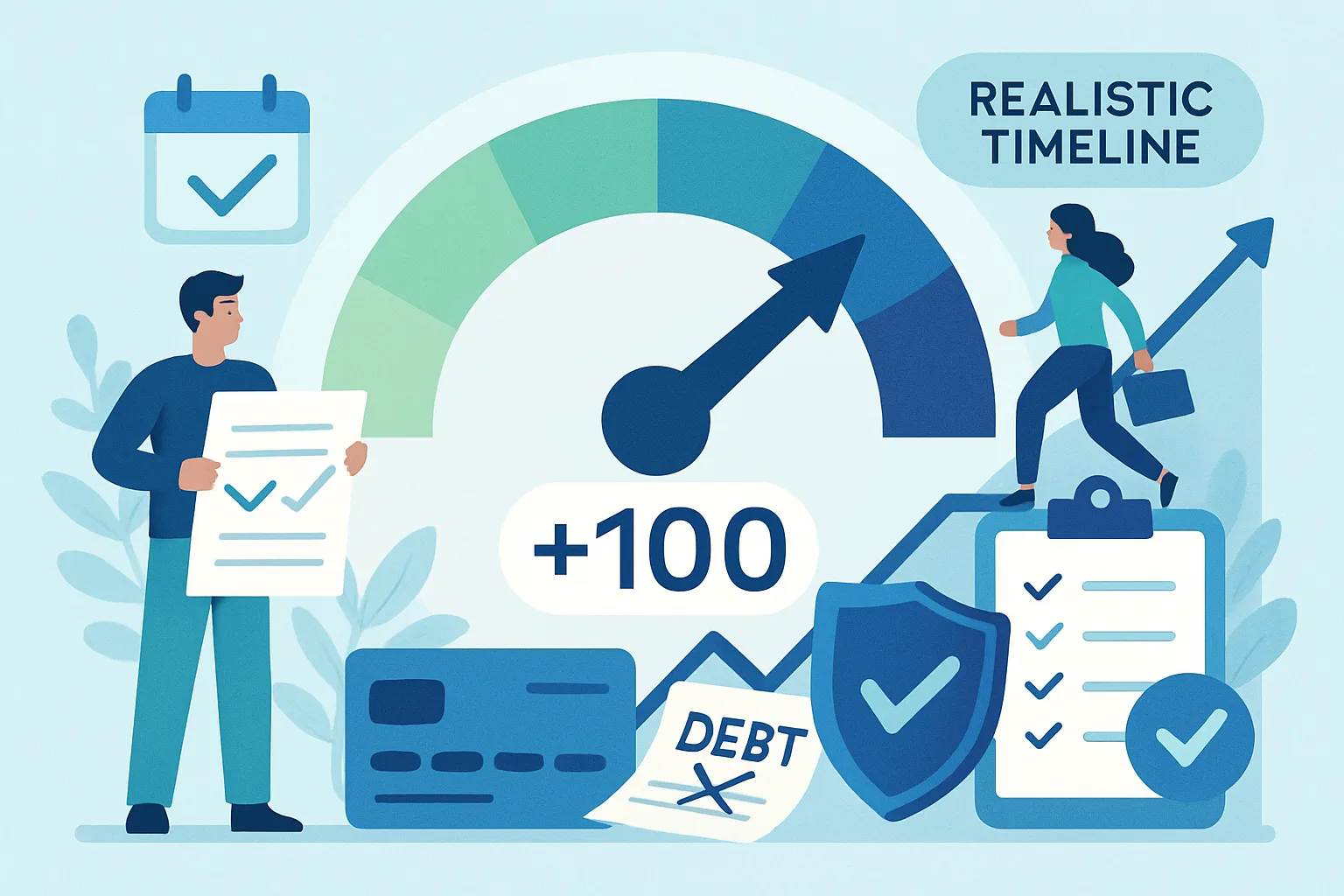
- Disputing errors on your credit report can yield quick wins in 30–60 days.
- Paying down credit card balances to below 30% utilization often boosts scores within 1–2 billing cycles.
- Becoming an authorized user on a well-managed account can add points in as little as 30 days.
If you've been wondering how to increase my credit score by 100 points, you're not alone. A 100-point jump can move you from fair to good credit, opening doors to better loan rates, credit card approvals, and even lower insurance premiums. The good news is that such a gain is achievable for many people—but it requires a clear strategy and realistic expectations.
Your credit score is a snapshot of your financial habits over time. While there's no magic switch, there are proven steps you can take to how to raise your credit score fast without falling for scams or quick fixes. This guide will walk you through the most effective methods, the typical timeline for each, and what to avoid along the way.
Remember, this information is for educational purposes and does not constitute financial advice. Everyone's credit situation is unique, so consider consulting a nonprofit credit counselor for personalized guidance.
What Does a 100-Point Credit Score Increase Mean?
A 100-point increase is a significant improvement. For example, moving from a 620 to a 720 can change your credit category from "fair" to "good" or "excellent." This shift can save you thousands in interest over the life of a loan. However, the time it takes depends on what's dragging your score down.
Common issues include late payments, high credit utilization, collections, or errors on your report.
It's important to understand that credit scores are calculated using data from your credit report. The two main scoring models are FICO and VantageScore, and most lenders use FICO. Both models weigh similar factors: payment history (35%), amounts owed (30%), length of credit history (15%), new credit (10%), and credit mix (10%).
To raise your score by 100 points, you'll need to improve one or more of these areas.
For instance, if your payment history is perfect but your utilization is high, focusing on paying down debt is your best bet. Conversely, if you have a late payment from two years ago, time and consistent on-time payments will gradually reduce its impact. Understanding which factor hurts you most is the first step to a targeted plan.
Why 100 Points Is a Realistic Goal
Many consumers have achieved a 100-point increase by addressing just two or three key factors. For example, someone with a 650 score due to 80% utilization and a single collection account could see a 100-point gain by paying off the debt and disputing a reporting error. The key is to identify the low-hanging fruit first.
However, if your score is already above 750, a 100-point gain is nearly impossible because you're already near the maximum. In that case, focus on maintaining your score rather than chasing a higher number. For those in the fair range (580–669), a 100-point jump is both achievable and life-changing.
How Long Does It Really Take to Raise Your Credit Score 100 Points?
The realistic timeline varies. Some changes can show results in 30 days, while others take months. Here's a general breakdown:
- 30–60 days: Disputing errors, paying down credit card balances to below 30% utilization, becoming an authorized user.
- 3–6 months: Consistent on-time payments, reducing utilization further, negotiating pay-for-delete with collectors.
- 6–12 months: Building a longer positive payment history, adding secured credit cards or credit-builder loans.
If you're asking "how can I raise my credit score in 30 days?" the answer is: focus on quick-impact actions like disputing errors and lowering utilization. But for a full 100-point gain, plan for several months of disciplined credit behavior.
For example, imagine you have a 580 score with two maxed-out cards and a recent late payment. Paying down the cards to 20% utilization could boost your score by 40–60 points in 60 days. Then, six months of on-time payments might add another 30–40 points.
The final push could come from becoming an authorized user or adding a secured card.
Step 1: Check Your Credit Reports for Errors
Before you can how to increase credit score quickly, you need to know what's on your credit report. You're entitled to one free report every 12 months from each of the three major bureaus (Equifax, Experian, TransUnion) at AnnualCreditReport.com. Review each report carefully for mistakes like incorrect late payments, accounts that aren't yours, or outdated negative items.
If you find errors, dispute them with the credit bureau. The dispute process typically takes 30 days, and if the error is removed, your score can rise quickly. According to the Consumer Financial Protection Bureau (CFPB), errors are common, so this step is worth your time.
You can file disputes online, by mail, or by phone. For more on what factors matter, see our guide on what affects your credit score.
Common errors include accounts that belong to someone with a similar name, duplicate debts, or incorrect dates of last payment. For instance, a medical bill from 2016 might still appear as unpaid even after insurance covered it. Disputing that error could remove the negative item entirely, giving you an instant score lift.
How to Dispute Efficiently
Start by gathering supporting documents, such as bank statements or payment confirmations. Write a clear explanation of the error and include copies (not originals) of your evidence. Submit your dispute online for the fastest processing, and keep a record of your dispute confirmation number.
After 30 days, the bureau must respond. If they verify the item as accurate, you can request a statement of dispute to be added to your file. This doesn't remove the item but shows lenders you disagree with it.
In some cases, this can still help your application.
Step 2: Lower Your Credit Utilization Ratio
Credit utilization—the amount of credit you're using compared to your limits—is a major factor. High utilization signals risk to lenders. Aim to keep your utilization below 30% on each card and overall.
For a 100-point boost, try to get it under 10% if possible.
How to do this: Pay down balances, request credit limit increases (but don't spend more), or spread balances across multiple cards. Even paying your balance twice a month can help. This strategy is one of the fastest ways to how to raise your credit score fast because utilization has no memory—it's calculated based on your latest statement.
You can see improvement in one billing cycle.
For example, suppose you have a single card with a $1,000 limit and a $900 balance (90% utilization). Paying it down to $300 (30% utilization) could raise your score by 30–50 points. Paying it down to $100 (10% utilization) might add another 20–30 points.
The effect is immediate once the new balance is reported.
Requesting Credit Limit Increases
If you have a good payment history, ask your card issuer for a higher limit. A higher limit automatically lowers your utilization if your balance stays the same. For instance, a $500 balance on a $1,000 limit is 50% utilization.
A $500 balance on a $2,000 limit is only 25% utilization. This can boost your score without paying down debt.
Be careful, though: some issuers perform a hard inquiry when you request an increase, which might temporarily drop your score by a few points. Ask if they can do a soft pull instead. Also, avoid increasing spending just because your limit is higher—that defeats the purpose.
Step 3: Make All Payments on Time
Payment history is the most important credit score factor. A single late payment can drop your score by 50–100 points, depending on your starting score. To raise your score, you need a streak of on-time payments.
Set up autopay or calendar reminders. If you've missed payments, catch up as soon as possible and stay current. Over time, the impact of past late payments fades.
If you're struggling with debt, consider a debt management plan through a nonprofit credit counseling agency. This can help you get back on track and show creditors you're committed.
For example, if you had a 30-day late payment six months ago, your score might still be depressed by 30 points. After 12 months of on-time payments, that late payment's impact diminishes significantly. After 24 months, it may have little to no effect.
Consistency is key.
What to Do If You Have Multiple Late Payments
If you have several late payments, focus on preventing new ones first. One new late payment can undo months of progress. Then, work on catching up any missed payments.
If you can't pay the full amount, contact the creditor to discuss hardship options. Some may agree to waive fees or set up a payment plan.
You can also write a goodwill letter to the creditor after you've made several on-time payments. Explain the circumstances of the late payment and ask for its removal as a courtesy. While not guaranteed, some creditors will oblige, especially if you have a long history with them.
Step 4: Become an Authorized User
If you have a family member or friend with a long history of on-time payments and low utilization, ask to be added as an authorized user on their credit card. The account's positive history will appear on your credit report, potentially boosting your score quickly—sometimes within 30 days. This is a legitimate way to how to increase credit score fast, but choose someone responsible, as their missteps could hurt your score too.
For instance, if your parent has a card with a $10,000 limit, a $1,000 balance, and 15 years of on-time payments, being added as an authorized user could add that entire history to your report. This can be especially helpful if you have a thin credit file. Your score might jump 50–100 points in a single month.
Risks and Limitations
The primary risk is that the primary account holder's negative behavior—like a late payment or high balance—will also appear on your report. So only choose someone with excellent credit habits. Also, some scoring models may not count authorized user accounts if you have a very young credit file, but most FICO models do.
Additionally, if the primary account holder removes you as an authorized user, the account may disappear from your credit report, and your score could drop. Use this strategy as a temporary boost while you build your own credit history.
Step 5: Use a Secured Credit Card or Credit-Builder Loan
If you have limited or damaged credit, a secured credit card can help you rebuild. You deposit a security deposit (e.g., $200) that becomes your credit limit. Use the card for small purchases and pay the balance in full each month.
After 6–12 months of responsible use, you may qualify for an unsecured card and get your deposit back.
Credit-builder loans from credit unions or online lenders also work: the lender holds the loan amount in a savings account while you make payments. Once paid off, you receive the money and a positive payment history. These tools are essential if you're wondering how to raise my credit score fast from a low starting point.
For example, a secured card with a $300 limit used for a $30 monthly subscription and paid in full each month will report positive payment history. After six months, you might see a 40–60 point increase. Adding a credit-builder loan for $1,000 with 12 monthly payments of $85 could add another 20–30 points.
Choosing the Right Secured Card
Look for a secured card that reports to all three credit bureaus and has a low annual fee. Some cards, like the Discover it Secured, offer rewards and automatic reviews for upgrading to an unsecured card after eight months. Avoid cards with high fees or those that don't report to the bureaus, as they won't help your score.
Also, ensure the card issuer reports your account as "secured" or "unsecured" to the bureaus. Most do, but it's worth confirming. Once you've built enough credit, you can close the secured card or upgrade it, but keep the account open to maintain your credit history length.
Step 6: Negotiate with Creditors or Collection Agencies
If you have accounts in collections, you can try a "pay-for-delete" agreement: you pay the debt (or a partial settlement) in exchange for the collection agency removing the account from your credit report. Not all agencies agree, but it's worth asking. Get the agreement in writing before paying.
For late payments that are accurate but old, you can write a goodwill letter to the original creditor explaining your circumstances and asking them to remove the negative mark as a courtesy. This is a long shot but can work if you have a generally good history.
For example, if you have a collection account for a $500 medical bill, offering to pay $300 in exchange for deletion might succeed. Some collection agencies are willing to negotiate because they paid pennies on the dollar for the debt. A written agreement ensures they follow through.
What to Do If Pay-for-Delete Fails
If the collector refuses, consider paying the debt anyway. While a paid collection is better than an unpaid one, it may not improve your score much. However, some newer FICO models ignore paid collections entirely, so it could help if a lender uses that version.
Also, paying the debt stops collection calls and potential lawsuits.
Another option is to wait. Most negative items fall off your credit report after seven years from the original delinquency date. If the collection is already four years old, waiting three more years might be the best strategy, especially if the amount is small.
Step 7: Avoid Closing Old Credit Cards
Closing old accounts reduces your available credit and shortens your credit history, both of which can lower your score. Even if you don't use an old card, keep it open (use it occasionally to avoid inactivity closure). This helps your utilization and history length.
If you're tempted to close a card with an annual fee, consider downgrading to a no-fee version instead.
For instance, if you have a card you've held for 10 years with a $5,000 limit, closing it removes that limit from your available credit. If you have another card with a $2,000 limit and a $1,000 balance, your utilization jumps from 14% ($1,000/$7,000) to 50% ($1,000/$2,000). That alone could drop your score by 30–50 points.
How to Keep Old Cards Active
Use each card at least once every six months to prevent the issuer from closing it due to inactivity. A small recurring charge, like a Netflix subscription or a monthly streaming service, works well. Set up autopay to ensure the balance is paid in full each month, avoiding interest charges.
If the card has an annual fee and you don't want to pay it, call the issuer and ask to downgrade to a no-fee version. For example, you might switch from a premium travel card to a basic cash-back card. This preserves the account's history and credit limit without the annual cost.
Step 8: Limit New Credit Applications
Every time you apply for credit, a hard inquiry appears on your report, which can temporarily lower your score by a few points. Multiple inquiries in a short period signal risk. So, avoid applying for new credit unless necessary.
If you're shopping for a loan, do it within a 14–45 day window to count as a single inquiry.
For those new to credit, our guide on how to build credit offers step-by-step advice.
For example, if you apply for three credit cards in one month, each application generates a hard inquiry. Your score might drop by 10–15 points total. Those inquiries stay on your report for two years, though they only affect your score for the first 12 months.
Limiting applications to one every six months is a safe rule.
When It's Okay to Apply
Applying for new credit is necessary when you need a loan or want to add a card to improve your credit mix. Just be strategic. For instance, if you have only credit cards, adding an installment loan (like a credit-builder loan) can improve your credit mix and potentially raise your score.
But only apply if you're confident you'll be approved.
Use pre-qualification tools that do a soft pull to check your odds before applying. Many card issuers offer this on their websites. A soft pull doesn't affect your score, so you can shop around without risk.
Can You Raise Your Credit Score 100 Points in 30 Days?
It's possible but challenging. The most realistic path to a 30-day boost involves: disputing errors (which can remove negative items), lowering utilization dramatically (e.g., from 90% to 10%), and becoming an authorized user on a well-managed account. Some people see 50–80 points in a month, but a full 100 points often requires more time.
If you're searching for "how can i raise my credit score in 30 days," focus on these high-impact actions. But beware of companies promising quick fixes—they're often scams. Legitimate improvement takes effort.
For example, a person with a 580 score due to a single error showing a $2,000 collection that isn't theirs could see a 100-point jump in 30 days after the dispute is resolved. Similarly, someone with a 620 score and 95% utilization who pays down to 5% might gain 80 points in 30 days. But these are best-case scenarios.
Common Mistakes That Slow Your Progress
- Paying off collections without negotiating removal: Paying a collection updates it to "paid" but doesn't remove it. Your score may not improve much.
- Closing credit cards after paying them off: This can lower your available credit and increase utilization.
- Using a credit repair company that promises too much: You can do most of this yourself for free.
- Ignoring your credit report for months: Regular monitoring helps you catch errors and track progress.
Another common mistake is paying off a collection without first asking for a pay-for-delete. As mentioned, a paid collection still appears on your report and can continue to drag down your score. Always negotiate removal first.
Also, avoid applying for multiple credit cards in a short period to "build credit." Each application adds a hard inquiry, and if you're denied, it's a wasted effort. Instead, focus on improving your existing accounts first.
How to Track Your Progress
Many credit card issuers offer free credit scores. You can also use services like Credit Karma or Experian's free tier. Check your score monthly to see how your actions affect it.
Remember that scores can fluctuate, so focus on trends rather than day-to-day changes.
Also, check your credit report every four months by rotating through the three bureaus (e.g., Equifax in January, Experian in May, TransUnion in September). This keeps you informed without paying.
For instance, if you see your score drop by 10 points one month, don't panic. It might be due to a slight increase in utilization or a new inquiry. Look at the bigger picture over three to six months.
If your score is trending upward, you're on the right track.
Using Credit Monitoring Alerts
Set up alerts for changes to your credit report, such as new accounts or inquiries. Many free services offer this. Alerts help you catch identity theft early and ensure that your disputes are processed correctly.
For example, if a collection account you disputed disappears, you'll get an alert and can confirm the score increase.
Also, some monitoring services provide score simulators that show how different actions might affect your score. For example, you can see the potential impact of paying down a specific balance or closing an account. Use these tools to plan your next steps.
When to Seek Professional Help
If you're overwhelmed by debt or don't see progress after six months of effort, consider a nonprofit credit counselor. They can help you create a budget, negotiate with creditors, and set up a debt management plan. Avoid for-profit credit repair companies that charge upfront fees—they often do what you can do yourself.
For a deeper dive into strategies, read our complete guide on how to raise your credit score fast.
Nonprofit credit counseling agencies, like those affiliated with the National Foundation for Credit Counseling (NFCC), offer free or low-cost services. They can review your credit report, identify the biggest issues, and create a personalized plan. This is especially helpful if you have multiple debts or are considering bankruptcy.
Additional Strategies for a 100-Point Boost
Beyond the core steps, there are additional strategies that can help you reach that 100-point goal faster. For example, if you have a mix of credit types, you might consider adding an installment loan. A small personal loan or auto loan can diversify your credit mix, which accounts for 10% of your FICO score.
Another strategy is to ask for a goodwill adjustment for a single late payment. If you have a generally positive history, a creditor might remove the late payment as a courtesy. Write a polite letter explaining the situation and emphasizing your otherwise good record.
This can remove a significant negative item.
Using a Credit-Builder Loan Strategically
Credit-builder loans are specifically designed to help you build credit. The lender deposits the loan amount into a savings account, and you make monthly payments. At the end of the term, you receive the money.
This creates a positive payment history and adds an installment account to your report.
For example, a 12-month credit-builder loan for $1,000 with monthly payments of $85 will report 12 on-time payments. This can boost your score by 20–40 points, especially if you have a thin file. Combine this with a secured card for maximum effect.
Understanding the Role of Credit Age
Length of credit history makes up 15% of your FICO score. If you have a short credit history, you might struggle to reach a 100-point increase quickly. However, you can still make progress by focusing on other factors like utilization and payment history.
Becoming an authorized user on an old account can help here. For instance, if you're added to a card that's 15 years old, that account's age is added to your credit report. This can significantly boost your average account age, potentially adding 20–30 points to your score.
Also, avoid closing your oldest accounts, as that shortens your credit history. If you must close a card, close the newest one first. This minimizes the impact on your average account age.
How to Handle Medical Debt
Medical debt is treated differently by some scoring models. Recent changes to FICO and VantageScore reduce the impact of paid medical collections. If you have medical debt in collections, paying it off might not hurt your score as much as other types of debt.
However, unpaid medical collections can still lower your score. If you have medical bills, first check if they were reported correctly. Many medical bills are sent to collections in error.
Dispute any inaccuracies, and if the debt is valid, negotiate a payment plan or settlement.
For example, a $500 medical collection that's paid might not affect your FICO 9 score at all, but it could still impact older versions. If you're applying for a mortgage, lenders might use an older model, so it's best to resolve medical debt proactively.
Key takeaways
- Raising your credit score by 100 points is realistic within 3–12 months with consistent effort.
- Quick wins include disputing errors, lowering credit utilization, and becoming an authorized user.
- On-time payments and avoiding new credit applications are essential for sustained improvement.
- Monitor your credit reports regularly and beware of scams promising instant results.
- Consider nonprofit credit counseling if you need help managing debt.
Frequently asked questions
Can I raise my credit score 100 points in 30 days?
What is the fastest way to increase my credit score by 100 points?
Will paying off collections raise my credit score 100 points?
How many points does a late payment drop your credit score?
Does closing a credit card help raise your credit score?
This article is for general informational purposes only and does not constitute financial, legal or credit-repair advice. Always consult a qualified financial advisor or credit counselor about your specific circumstances.

Written & reviewed by
Can OTUEditor
Can OTU is the editor of this site, curating and reviewing every guide for accuracy and clarity.
View all guides →