Is Credit Repair Worth It for a 600 Credit Score?

- Paid credit repair is genuinely worth it when your reports contain real errors, duplicates, or identity theft — and only then.
- The biggest score jumps at 600 come free: pay balances down below 30% (ideally 10%) of your limits, stay current, and stop applying for new credit.
- Expect weeks for utilization fixes to show up and roughly 30–45 days for a dispute to be resolved. Getting from 600 to 700 usually takes months, not weeks.
A 600 credit score feels worse than it is. You're in "fair" territory — not subprime, not hopeless, and not far from the 620–640 range where a lot more lending options open up. Plenty of people sit at 600 for years because of one maxed-out card or one late payment, not because they're bad with money.
So when a credit repair company promises to "get negative items removed" and "boost your score fast," it's fair to wonder whether the fee is worth it. The honest answer depends entirely on what's actually sitting in your credit reports right now.
This article walks through what credit repair can and can't do at 600, what it costs, how long the timelines really run, and how to decide which path wins for your situation. Everything here is general information, not financial advice — your specific circumstances deserve a one-on-one review.
Is credit repair worth it for a 600 credit score? The direct verdict
For the majority of readers at 600, the answer is no — paid credit repair isn't worth it. Here's the reasoning in plain terms.
Credit repair companies do one core thing: they dispute information on your credit reports and push creditors and bureaus to verify it. If the item can't be verified, it comes off. That's legal, useful, and covered by federal law.
But a 600 score is rarely caused by unverifiable errors. It's caused by things that are accurate and legitimate: a card at 90% utilization, a 30-day late payment from 18 months ago, a two-year credit history, or a collection you actually owe. No company can delete accurate information, no matter what the salesperson implies.
So the money often buys you paperwork — not a better score. The exception: if your reports contain genuine mistakes, duplicates, accounts that aren't yours, or debts discharged in bankruptcy that still show a balance, a legitimate credit repair firm can compress months of frustrating back-and-forth into a few weeks. That's the narrow case where the fee earns its keep.
What does a 600 credit score actually cost you?
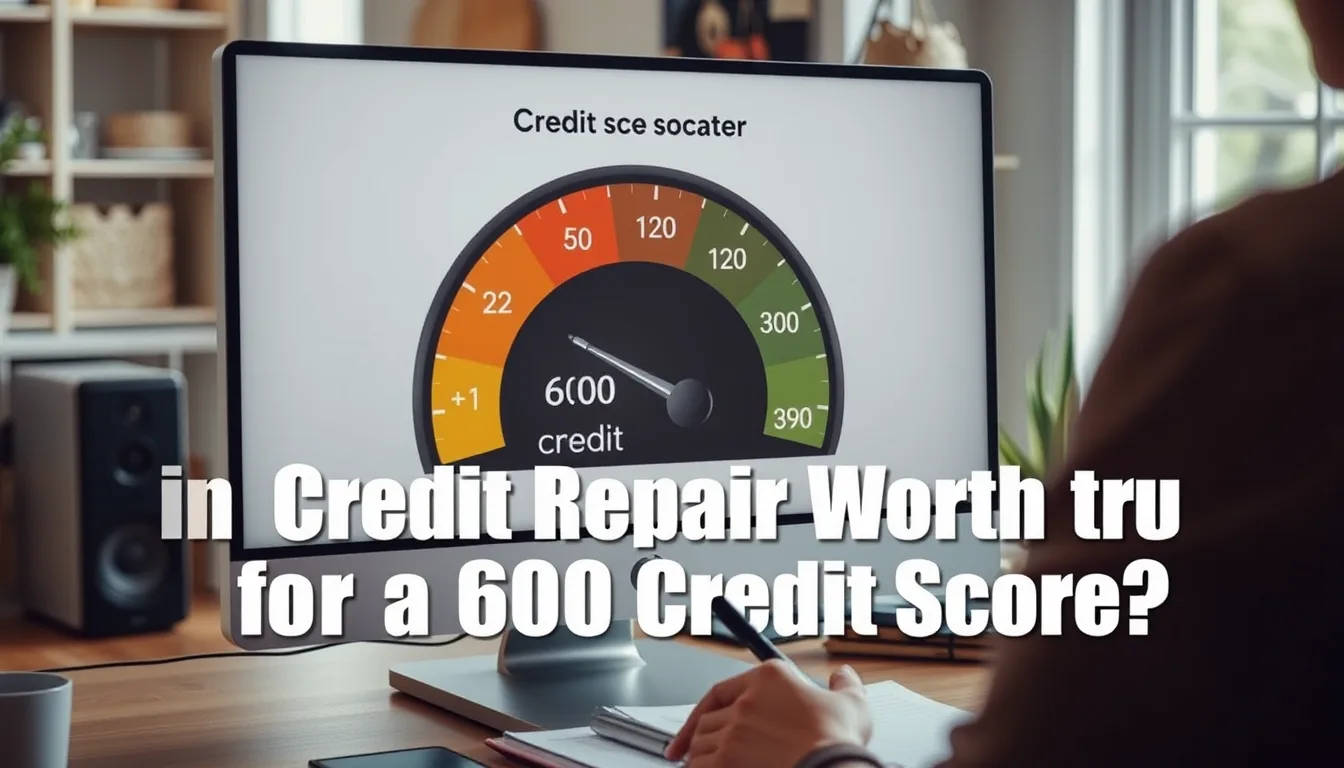
FICO scores run from 300 to 850, and 600 lands in the "fair" band (roughly 580–669). It's the middle of the road, and lenders treat it that way.
At 600, you'll usually qualify for credit cards and auto loans, but with higher rates and smaller limits. Mortgages get tighter — many conventional lenders want 620 or higher, and FHA loans typically need 580 with a 3.5% down payment. Renters may face bigger deposits.
Here's the part that stings. Moving from 600 to 700 can shift your interest rate by a meaningful margin on a large loan. On a mortgage, even half a percentage point difference can add up to tens of thousands of dollars over 30 years.
The exact number depends on your lender and the market, so treat that as illustrative — but the direction is real.
| Score band | What it typically unlocks | What it typically blocks |
|---|---|---|
| Below 580 | Secured cards, some subprime auto loans | Most unsecured cards, most mortgages |
| 580–619 (you're here at 600) | FHA loans with larger down payments, store cards, some auto loans | Best rates, premium cards, some rentals |
| 620–669 | Conventional mortgages, mainstream cards | Top-tier pricing |
| 670–739 | Most loans at competitive rates | Very little |
That table is a general guide, not a guarantee — every lender sets its own rules. The takeaway is simpler: at 600 you're not locked out. You're paying a premium.
What credit repair can and can't do for a 600 score
Knowing the boundary between the two is the whole game. Here's the split.
What a legitimate credit repair company can do
- Dispute inaccurate, incomplete, or unverifiable items with all three bureaus (Equifax, Experian, TransUnion).
- Challenge duplicate collections — the same debt listed twice, or listed by both the original creditor and a collector.
- Clean up identity theft damage, including accounts opened in your name.
- Push creditors to correct reporting errors like a paid collection showing as unpaid, or a closed account showing a balance.
- Handle the paperwork and follow-up timelines so you don't have to.
What no company can legally do
- Remove accurate late payments, charge-offs, or collections that genuinely belong to you.
- Erase a bankruptcy before its reporting period ends (usually 7–10 years).
- Guarantee a specific score or a specific number of points.
- Create a "new credit identity" with a different Social Security number — that's a federal crime.
- Make legitimate negative history disappear just because you paid the debt.
Paying a debt does not remove the negative mark. It updates the balance to zero, which helps a little, but the late payment or collection stays for up to seven years. That surprises a lot of people, and it's exactly what shady companies exploit.
Credit repair company vs. DIY: side-by-side comparison
You can do almost everything a credit repair company does, for free. The trade-off is time and hassle, not legality or access.
| Factor | Professional credit repair | DIY credit repair |
|---|---|---|
| Typical cost | Roughly $50–$150 per month, or a flat fee per dispute round. Some states cap what they can charge. | Free. Certified mail postage runs a few dollars per letter. |
| Your time | Low — you forward documents and wait | Moderate — a few hours upfront, then follow-ups |
| Speed | Slightly faster if you have many errors across all three bureaus | About the same for one or two simple errors |
| Control | Limited — you don't see every letter | Total — you know exactly what's being disputed |
| Risk | Real — scams and predatory firms exist | Low, but you can make mistakes |
| Best for | Identity theft, dozens of errors, or a genuinely confusing file | One or two errors, high utilization, or a thin file |
One thing worth flagging: a credit repair company cannot do anything for you that you can't do yourself. There's no secret database, no insider channel, no special leverage. The difference is labor, not magic.
How much does credit repair cost — and is it worth the money at 600?
Pricing varies by state because several states cap credit repair fees. Where it's allowed, you'll typically see a setup fee in the $50–$150 range, then a monthly fee of roughly $50–$150 per month for as long as you stay enrolled.
Some firms charge per dispute round instead. Others bundle credit repair with debt settlement and take a percentage of enrolled debt — that's a different service entirely, usually 15–25% of the debt amount, and it has very different risks.
Federal law matters here. The Credit Repair Organizations Act (CROA) prohibits companies from charging you before services are performed, requires written contracts, and gives you a three-day right to cancel. If a company asks for an upfront payment before doing any work, that's a red flag, not a special deal.
Now the math on value. Say you pay $99 a month for six months — about $600 — to dispute two errors. If you could have written those two letters yourself in an afternoon, the fee bought convenience, not results.
But if your file has fifteen errors across three bureaus plus a fraud case, $600 for skilled handling may be a bargain.
Ask yourself one question: how many items on my reports are actually wrong? If the answer is "none" or "I'm not sure," pull your reports free at AnnualCreditReport.com before you pay anyone.
How long does it take to improve credit score? Realistic timelines
This is the question almost everyone asks next, and the honest answer is that it depends on which lever you pull.
Paying down a maxed-out card can lift your score within one billing cycle — sometimes within days of the new balance reporting to the bureaus. Disputes take longer: the bureaus generally have about 30 days to investigate, and up to 45 days if you send additional information mid-process. Add mailing time on both ends and you're looking at roughly four to six weeks per round.
Late payments, collections, and charge-offs stay on your reports for seven years from the date of the original delinquency. You can't speed that up — but their impact fades as the account ages and as newer positive history builds.
| Action you take | How long until it shows on your score |
|---|---|
| Pay balances below 30% (or 10%) of your limits | Usually one billing cycle, often 2–6 weeks |
| Dispute an error with the bureaus | Roughly 30–45 days per round, plus mailing |
| Late payment added to your report | Appears within a month or two; stays up to 7 years |
| Hard inquiry from a new application | Appears immediately; affects scoring for about 12 months |
| Collection account | Can report for 7 years plus 180 days from delinquency |
| Chapter 7 bankruptcy | Up to 10 years |
So when people ask how long does it take for a credit score to increase, the real answer is: the fast wins are weeks, the structural wins are months, and the negatives are years. All three happen on different clocks.
How long does it take to raise a 600 credit score to 700?
Realistically, six to twelve months for most people — and that's if you're consistent. Anyone promising a 100-point jump in 30 days is selling something.
The first 50 points tend to come faster. If your score is being dragged down by high utilization, paying balances down can move you from 600 to 650 in two or three billing cycles.
Getting from 650 to 700 is slower because you've usually fixed the easy stuff. Now you're waiting on time — for late payments to age, for your average account age to grow, for a clean payment streak to build. There's no shortcut for that part.
- 600 to 630: often 1–3 months with utilization fixes and one dispute round.
- 630 to 660: another 3–6 months, assuming no new negatives.
- 660 to 700: typically 6–12 months of clean history and low balances.
Those ranges are illustrative, not promises. Someone with a seven-year clean history and one maxed card will move much faster than someone with three recent lates.
How can I raise my credit score in 30 days?
Thirty days is tight but not useless. You won't hit 700, yet you can absolutely see movement. Here's what actually works within a month.
- Pay your balances down before the statement closing date. Your card reports the balance on your statement, not your due date. Paying early means a lower balance gets reported.
- Get every revolving account under 30% of its limit, then aim for 10%. Utilization is the fastest-moving factor in your score.
- Dispute anything that's clearly wrong. You can file online with each bureau. Results take about 30 days, so file in week one.
- Ask for a credit limit increase on cards you've handled well. A higher limit lowers your utilization percentage without paying a cent — just confirm it won't trigger a hard inquiry.
- Become an authorized user on a family member's well-managed, low-balance card. You inherit the account's history without being responsible for the bill.
- Don't apply for anything new. Each application adds a hard inquiry and, if approved, lowers your average account age.
If you need a score bump for a specific reason — a mortgage pre-approval, an apartment application — tell your loan officer or landlord what you're doing. Sometimes a documented explanation plus a rapid rescore (a lender-side process) beats waiting.
How to improve credit score fast: the five moves that actually move the needle
If you only do five things, do these. They're ranked by real-world impact at a 600 score.
- 1. Fix utilization first. It's roughly 30% of your FICO score and it's the only major factor you can change this month.
- 2. Never miss a payment again. Payment history is about 35% of your score, the single biggest piece. Set autopay for at least the minimum on everything.
- 3. Clean up genuine errors. One wrong collection can cost you dozens of points. This is free to dispute.
- 4. Keep old accounts open. Closing your oldest card shortens your average history and raises utilization. Both hurt.
- 5. Add positive history deliberately. A secured card or credit-builder loan gives the bureaus new on-time payments to score.
That list is the backbone of our guide on how to raise your credit score fast, which goes deeper on sequencing and timing.
What doesn't work: credit sweepers, "tradeline" schemes that add fake authorized-user accounts, and any service promising to erase accurate history. They range from useless to illegal.
What affects your credit score most when you're at 600?
Two categories do almost all the damage. Payment history (about 35%) and amounts owed (about 30%) together make up roughly two-thirds of your FICO score.
- Payment history — 35%: late payments, collections, charge-offs, bankruptcies, public records.
- Amounts owed — 30%: your utilization ratio, both per card and overall.
- Length of credit history — 15%: average account age and how old your oldest account is.
- New credit — 10%: hard inquiries and recently opened accounts.
- Credit mix — 10%: having both revolving and installment accounts.
At 600, the culprit is usually one of three things: a card near its limit, a recent late payment, or a very short file. Each one has a different fix, which is why blanket advice fails. Our breakdown of what affects your credit score covers each factor in detail.
And if your problem is that you barely have a file at all, that's a different conversation. Thin files need new accounts, not disputes — here's how to build credit when you're starting close to zero.
When is credit repair actually worth it at 600?
These are the situations where paying a professional is a reasonable call — not because they have secret powers, but because the work is genuinely complex or you're out of bandwidth.
- You're a victim of identity theft. Multiple accounts you never opened, plus the disputes, affidavits, and follow-up that come with them.
- You have documented errors across all three bureaus. Fifteen or twenty inaccurate items is a lot of letters.
- A debt was discharged in bankruptcy but still reports a balance. Common, fixable, and irritating to chase down.
- The same collection appears twice, or appears from both the original creditor and a collector.
- A paid collection is still reporting as unpaid, or as paid with a balance.
- Your file is mixed with someone else's — same name, similar SSN, different person.
In each case, the value isn't a guaranteed score jump. It's corrected data. Once the bad entries are gone, your real score shows up — and it's often higher than you think.
When is credit repair not worth it — and what to do instead
Skip it in these cases. You'll save hundreds of dollars and lose nothing.
- Your reports are accurate. If there are no errors, there's nothing to dispute.
- Your balances are maxed out. That's a budgeting problem, not a reporting problem.
- You have one recent late payment. It'll age off on its own. A goodwill letter to the creditor is free and sometimes works.
- Your file is thin or young. You need more positive history, not disputes.
What to do instead depends on the cause. High-interest debt that's suffocating your budget? A nonprofit credit counseling agency — look for one through the National Foundation for Credit Counseling — can set up a debt management plan that lowers rates and consolidates payments.
Credit counseling sessions are often free or low cost.
No cash to pay balances down? Focus on the minimums, stop new charges, and let time and on-time payments do the work. Slow, but it's free and it compounds.
How to avoid credit repair scams
The Consumer Financial Protection Bureau is blunt about this industry: no one can remove accurate negative information, and companies that promise otherwise are lying. The FTC tracks the same pattern year after year.
Red flags that should end the conversation immediately:
- They want payment before any work is done. CROA prohibits it.
- They tell you to stop contacting the credit bureaus directly, or to dispute everything regardless of accuracy.
- They promise to remove accurate items or guarantee a specific score.
- They suggest a new Social Security number or an EIN "for credit purposes." That's fraud.
- They pressure you to sign now, or they won't put the contract in writing.
- They claim to be affiliated with the government.
Check for a license if your state requires one, read the contract for the three-day cancellation clause, and remember that you can file disputes yourself at no cost with all three bureaus online.
Common myths about credit repair and a 600 score
A few beliefs keep people stuck — or paying for things they don't need.
"Checking my own score hurts it." It doesn't. Checking your own credit is a soft inquiry and has no effect on your score. Only applications for new credit create hard inquiries.
"Closing my cards will help." Usually the opposite. Closing a card reduces your available credit, which pushes utilization up, and it shortens your average account history.
"Paying off a collection removes it." No. It updates the balance. The collection itself stays for seven years.
"I need a company to dispute." You don't. The bureaus accept disputes directly from consumers, online or by mail, free.
"Credit repair is the same as debt settlement." They're different services with different risks. Settlement means paying less than you owe, usually by stopping payments first — which damages your score before it might help.
A realistic 90-day plan for a 600 credit score
Here's what a focused three months actually looks like. No fees required.
Weeks 1–2: Get the facts. Pull all three reports. Print them. Highlight every balance, every late mark, every collection, and every account you don't recognize.
Note your utilization on each card.
Weeks 3–4: File disputes for anything wrong. Do it online, one bureau at a time, and keep every confirmation number. Then set the balance in motion: pay down whichever card is closest to its limit.
Weeks 5–8: Attack utilization. Get every card below 30%, then below 10% if you can. Ask for limit increases on cards in good standing. Move autopay dates to line up with your paychecks.
Weeks 9–12: Build positive history. If your file is thin, open one secured card and use it lightly. Do not apply for anything else. When the dispute results come back, review them and re-dispute anything still unverified.
By day 90, if utilization was the problem, you should see movement. If errors were the problem, you may see a bigger jump. If neither was the problem — if it's a recent late payment or a young file — you'll see little change, because time is the only fix.
Key takeaways
- Verdict: For most 600 scores, DIY wins. Paid credit repair is only worth it when there are real, documented errors or identity theft.
- A 600 score is workable. It's "fair," not failing — FHA loans, secured cards, and auto loans are generally available.
- Fastest lever: pay revolving balances below 30%, then 10%, of your limits. Results often show within one billing cycle.
- How long to raise a score: weeks for utilization, roughly 30–45 days per dispute round, and six to twelve months to move from 600 to 700 in most cases.
- Watch the red flags. Upfront fees, guaranteed deletions, and "new identity" offers are violations of federal law.
- You can do this yourself. Pull your free reports, dispute what's wrong, keep paying on time, and let the rest age.
Frequently asked questions
Will credit repair raise my 600 credit score?
How long does it take to see results after disputing an item?
Is a 600 credit score bad?
Can I raise a 600 credit score to 700 in three months?
Should I pay a collection or dispute it?
This article is for general informational purposes only and does not constitute financial, legal or credit-repair advice. Always consult a qualified financial advisor or credit counselor about your specific circumstances.

Written & reviewed by
Can OTUEditor
Can OTU is the editor of this site, curating and reviewing every guide for accuracy and clarity.
View all guides →