Pay for Delete: Does It Work and How to Do It
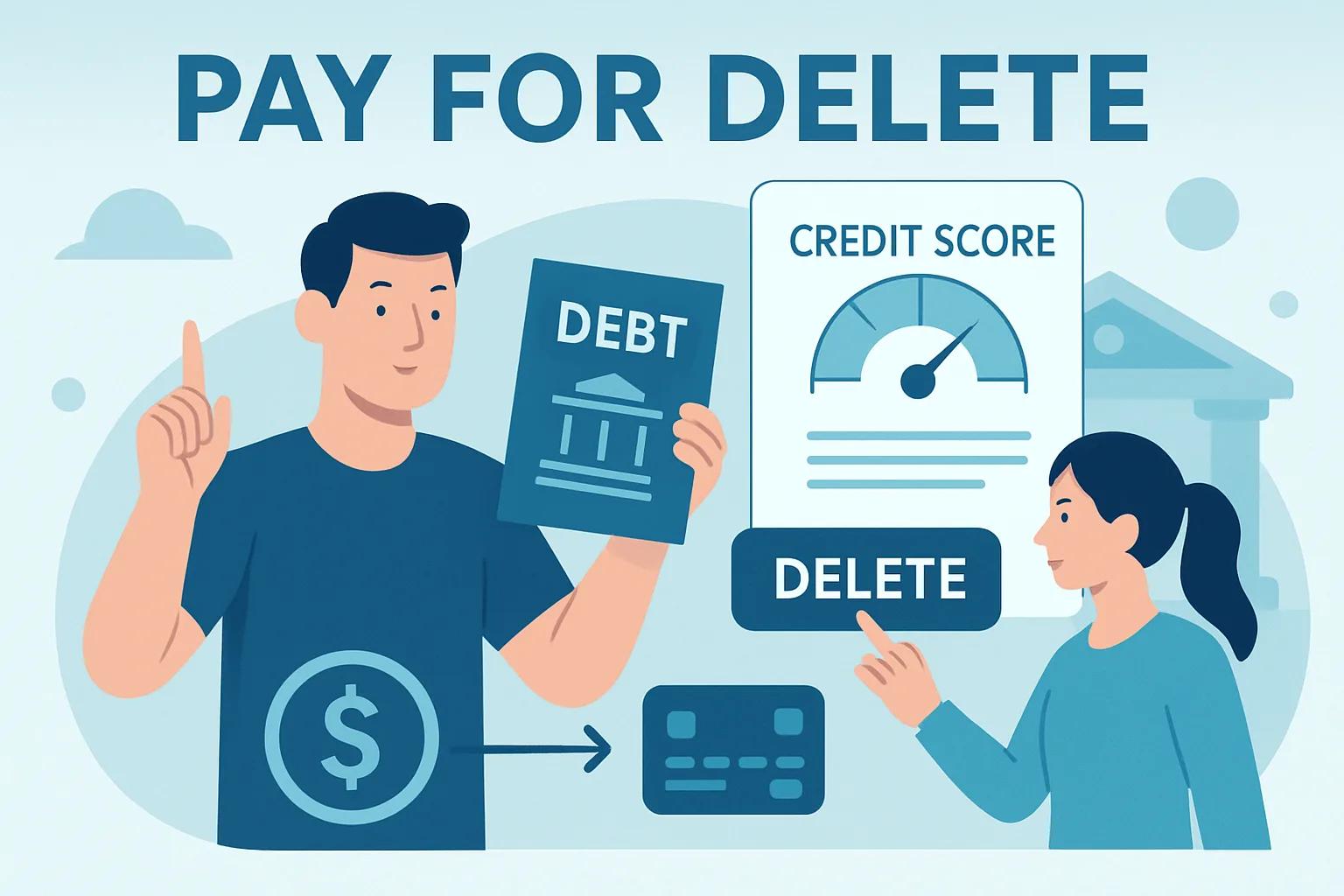
- Pay for delete is not required by law, but some collectors agree to it
- Get any agreement in writing before you pay
- If pay for delete fails, you still have other options like disputing errors or waiting for the item to age off
If you have a collection account on your credit report, you know how much it can drag down your credit scores. You might be wondering how to delete collections on credit report quickly. One strategy you may have heard of is called "pay for delete." But does it really work? And how do you do it? In this article, we'll explain what pay for delete is, how to negotiate it, and what to do if it doesn't work.
First, a quick note: This article is for informational purposes only and does not constitute financial or legal advice. Every credit situation is unique, and you may want to consult with a credit professional or attorney for personalized guidance.
Let's start with the basics: When a debt goes to collections, the original creditor typically sells the debt to a collection agency. That agency then reports the account to the credit bureaus, which damages your credit. Pay for delete is an arrangement where you pay the collection agency, and in return, they agree to remove the negative item from your credit report entirely. It's different from simply paying the debt, which usually updates the status to "paid" but doesn't remove the account.
Does Pay for Delete Actually Work?
The short answer is: sometimes, but not always. Pay for delete is not a legal requirement. The credit bureaus (Equifax, Experian, and TransUnion) have policies that discourage collectors from deleting accurate information. However, many collection agencies are willing to negotiate because they want to get paid. If you can convince them that deleting the account is in their best interest, you may succeed.
Success rates vary. Some collectors have a strict policy against pay for delete, while others are open to it. Smaller, independent agencies are often more flexible than large national ones. Your leverage also matters: if the debt is old or the collector has limited documentation, they may be more willing to delete.
It's important to know that even if the collector agrees, the credit bureaus might still refuse to remove the item if they detect the deletion violates their rules. However, in practice, if the collector instructs the bureau to delete, it usually happens.
To illustrate, consider a scenario where you have a $500 medical collection from a small regional agency. The agency may be more inclined to accept a pay-for-delete offer because they want to close the account quickly and avoid further administrative costs. In contrast, a large national agency handling thousands of accounts might have automated systems that refuse such requests. Another example: if the debt is several years old and the collector has already written it off as a loss, they may see a pay-for-delete as a way to recover something rather than nothing. The key is to approach each situation with realistic expectations and persistence.
How to Negotiate a Pay for Delete Agreement
Negotiating a pay for delete requires preparation and clear communication. Here's a step-by-step guide.
Step 1: Get a Copy of Your Credit Report
Before you do anything, pull your credit reports from all three bureaus at AnnualCreditReport.com. This free weekly report is your right under federal law. Look for the collection account you want to remove. Note the collection agency's name, address, phone number, and the account number. Also check for any inaccuracies — if there are errors, you can how to dispute errors on your credit report instead, which might be easier.
For example, if you see a collection for $1,200 but you know the original debt was only $800, that discrepancy could be grounds for a dispute. Or if the account shows a date of first delinquency that is incorrect, you might be able to challenge it. Taking the time to review your report thoroughly can reveal opportunities that make pay-for-delete unnecessary.
Step 2: Contact the Collection Agency
Call the collection agency or send a letter. Be polite and professional. Explain that you are willing to pay the debt in full (or a settlement amount) if they agree to delete the account from your credit report. Use the term "pay for delete" or "deletion in exchange for payment." You can say something like: "I'd like to resolve this account. If I pay the balance, will you remove the negative item from my credit report?"
Let's say you owe $2,000 on a credit card that went to collections. You might call and say, "I can pay $1,500 today if you agree to delete this account from my credit report. Can we make that arrangement?" The collector may counter with a higher amount, but the conversation opens the door. Always keep notes of who you spoke with, the date, and what was said.
Step 3: Get the Agreement in Writing
If the collector agrees verbally, ask them to send you a written agreement stating that upon payment, they will request deletion from the credit bureaus. Do not pay until you have this in writing. Without written proof, you have no recourse if they don't follow through.
For instance, you might receive a letter that says, "Upon receipt of $1,500, we will instruct Equifax, Experian, and TransUnion to remove account number 12345 from your credit file." Keep this letter in a safe place. If the deletion doesn't happen, you can forward the letter to the credit bureau as evidence.
Step 4: Make the Payment
Once you have the signed agreement, pay according to the terms. Use a traceable method like a cashier's check or credit card. Keep all records.
Avoid paying with cash or a personal check that could be lost. A cashier's check provides a clear paper trail, and a credit card payment gives you a receipt. After paying, save the confirmation number and any email receipts.
Step 5: Monitor Your Credit Report
After 30-60 days, check your credit report to confirm the account is deleted. If it's not, contact the collection agency and the credit bureau to follow up.
For example, if you paid on June 1, check your report on July 15. If the collection is still there, call the agency and ask why the deletion hasn't occurred. Sometimes there's a delay in processing. If they fail to act, you can dispute the item with the credit bureau, citing the written agreement.
What If the Collector Refuses Pay for Delete?
If the collector says no, don't give up. You still have several options to improve your credit.
Dispute Inaccurate Information
If there are any errors on the collection account — wrong amount, incorrect date, or the debt isn't yours — you can dispute it with the credit bureaus. The Fair Credit Reporting Act (FCRA) gives you the right to challenge inaccurate items. The bureau must investigate and remove any errors. For a detailed guide, see how to remove collections from credit report.
Suppose the collection shows a balance of $3,000, but you have proof that the original debt was only $2,500. You can dispute the amount. Or if the account lists a date of first delinquency that is earlier than the actual missed payment, you can challenge that. The credit bureau will contact the collector, and if the collector cannot verify the information within 30 days, the item must be removed.
Request a Goodwill Deletion
If the debt is paid (even without a pay for delete), you can write a goodwill letter to the collection agency asking them to delete the account as a courtesy. This is more likely if you have a history of on-time payments or the debt was a one-time mistake.
For example, you might write, "I paid this debt in full last month. I understand that it was a mistake on my part, and I have since maintained excellent credit. Would you consider removing this item as a gesture of goodwill?" Some collectors are sympathetic, especially if you have a long history with them or if the debt was small. It's not guaranteed, but it's worth a try.
Wait for the Statute of Limitations or Time Limit
Collection accounts can only stay on your credit report for seven years from the date of the first missed payment. After that, they must be removed automatically. If the debt is old, you might just wait it out. Also, the statute of limitations for suing on the debt is shorter (usually 3-6 years), so if it's expired, the collector can't sue you.
Imagine you missed a payment on a credit card in January 2018. The collection account will fall off your report in January 2025. If you are already in 2024, waiting a few months might be the simplest path. Meanwhile, focus on building positive credit history to offset the impact.
Consider Credit Repair Services
Many people ask, do credit repair companies really work? The answer is: some do, but you need to be careful. Legitimate credit repair companies can help you dispute errors and negotiate with collectors, but they cannot do anything you can't do yourself for free. Be wary of companies that promise to remove accurate negative items or charge upfront fees (which is illegal under the Credit Repair Organizations Act). For more on this, see does credit repair really work later in this article.
Pay for Delete vs. Paying the Debt Without Deletion
Simply paying a collection account does not remove it from your credit report. Instead, the status changes to "paid collection." While this is better than an unpaid collection, it still hurts your score because the negative item remains. Pay for delete is the only way to get the account completely removed (aside from disputing errors or waiting seven years).
If you can't get a pay for delete, paying the debt might still be a good idea if you're applying for a mortgage or need to show lenders you've resolved the issue. But if your goal is to boost your credit score quickly, focus on negotiating deletion.
Consider this: a paid collection might still lower your score by 50-100 points, whereas a deleted collection could add 100 points or more. For example, if your score is 620 with a collection, paying it might bring you to 650, but deletion could push you to 700 or higher. The difference can affect loan approvals and interest rates.
Do Credit Repair Companies Really Work?
You might be considering hiring a credit repair company to handle pay for delete or other credit issues. The question do credit repair services really work is common. Here's what you need to know.
Credit repair companies can save you time and effort by sending dispute letters and negotiating on your behalf. They often have experience with the process and may know which collectors are more likely to agree to pay for delete. However, they cannot guarantee results, and you can do most of the same things yourself for free.
Be cautious: some companies charge high fees and make unrealistic promises. The Federal Trade Commission (FTC) warns that no credit repair company can remove accurate negative information from your credit report. If a company claims otherwise, it's a red flag. For more information, see the FTC's page on credit repair.
In short, does credit repair really work? Yes, but only for disputing inaccuracies and negotiating deletions — not for removing accurate, timely negative items. You can achieve similar results by following the steps in this article.
To give a concrete example, a credit repair company might charge $100 per month for six months to dispute a collection. If the collection is valid and accurate, they will likely fail. But if there is an error, they might succeed. However, you could have done the same dispute yourself by sending a letter to the credit bureau. The value of a credit repair company is convenience, not guaranteed results.
How to Delete Collections on Credit Report: Alternative Methods
If pay for delete isn't working, here are other ways to how to delete collections on credit report or at least minimize their impact.
Dispute the Collection
Under the FCRA, you have the right to dispute any inaccurate information. If the collection agency cannot verify the debt within 30 days, the bureau must remove it. Common errors include wrong account number, incorrect balance, or the debt belonging to someone else. Send a dispute letter to each credit bureau that shows the collection. Include copies of your credit report highlighting the error and any supporting documents.
For instance, if you have a collection for a utility bill that you never received, you can dispute it by saying, "I have no record of this account. Please verify the debt." If the collector cannot provide proof, the item is removed. This method is free and can be done online or by mail.
Ask the Original Creditor to Recall the Debt
Sometimes you can ask the original creditor (the company you originally owed) to take back the debt from the collection agency. This is called "recalling the debt." If they agree, the collection account will be removed, and you can then pay the original creditor directly. This is rare but worth a try if you have a good relationship with the original creditor.
For example, if you had a credit card with a bank and the debt went to collections, you might call the bank and say, "I want to pay this debt directly to you. Can you recall it from the collection agency?" Some banks have policies that allow this, especially if you are a long-time customer. If successful, the collection disappears from your report, and you pay the original creditor.
Use a Pay-for-Delete Letter Template
You can find sample pay-for-delete letters online. These letters formally request deletion in exchange for payment. Sending a letter rather than calling can create a paper trail and make the negotiation more official.
A typical letter might include: "I am willing to pay the full balance of $X in exchange for your agreement to delete this account from my credit report. Please confirm in writing that you will instruct the credit bureaus to remove this item upon receipt of payment." Sending it via certified mail with return receipt ensures you have proof of delivery.
The Role of the Credit Bureaus in Pay for Delete
Understanding how the credit bureaus handle pay-for-delete requests can help you navigate the process. The three major bureaus—Equifax, Experian, and TransUnion—have agreements with data furnishers (like collection agencies) that require accurate reporting. Pay for delete technically violates these agreements because it involves deleting accurate information. However, the bureaus rarely enforce this rule unless they detect a pattern of abuse.
When a collector agrees to pay for delete, they submit a request to the bureau to remove the account. The bureau typically processes this request without questioning it, as long as it comes from an authorized source. In rare cases, the bureau might flag the deletion and refuse it, but this is uncommon. For example, if a collector tries to delete multiple accounts for the same consumer, the bureau might investigate. But for a single deletion, it usually goes through.
It's also worth noting that the bureaus have different policies. Experian, for instance, has been known to be more strict about pay for delete than Equifax or TransUnion. However, in practice, most deletions succeed if the collector follows through. The key is to ensure the collector actually sends the deletion request, which is why written agreements are crucial.
How Pay for Delete Affects Your Credit Score Over Time
Removing a collection account can give your credit score a significant boost. The exact impact depends on your overall credit profile. For someone with a thin credit file, removing a collection could increase their score by 50-100 points or more. For someone with multiple negative items, the effect may be smaller.
It's also worth noting that paying a collection (without deletion) can sometimes cause a temporary score drop because the account is updated to a recent activity date. This is known as the "pay for delete paradox." But if you get the deletion, that risk disappears.
Consider two scenarios. In the first, you pay a $1,000 collection without deletion. Your score might drop 20 points temporarily because the account shows recent activity. Over time, it recovers, but the negative item remains for up to seven years. In the second scenario, you negotiate a pay for delete. The account is removed entirely, and your score jumps 80 points immediately. The long-term benefit is clear: a clean report allows you to qualify for better interest rates and credit cards.
Common Myths About Pay for Delete
There's a lot of misinformation about pay for delete. Let's clear up a few myths.
Myth 1: Pay for delete is illegal. It's not illegal, but it violates the credit bureaus' contracts with data furnishers. However, collectors sometimes do it anyway. The risk is that the bureau might refuse the deletion, but that's rare.
Myth 2: You must pay the full amount. Not necessarily. You can negotiate a settlement for less than the full balance, and still request deletion. Some collectors will accept a partial payment in exchange for deletion.
Myth 3: Pay for delete works every time. No. Success depends on the collector's policies, the age of the debt, and your negotiation skills. Be prepared for rejection.
Myth 4: You need a lawyer to do pay for delete. While a lawyer can help, especially if the collector has violated your rights, you can negotiate pay for delete yourself. The process is straightforward and doesn't require legal expertise.
Myth 5: Pay for delete only works for small debts. Not true. Even large debts can be negotiated if the collector is motivated. For example, a $10,000 medical debt might be settled for $6,000 with deletion if the collector wants to close the account.
Should You Use a Credit Repair Company for Pay for Delete?
If you're not comfortable negotiating yourself, a credit repair company can handle it. But before you hire one, ask these questions:
- What is your success rate with pay for delete?
- Do you charge upfront fees? (If yes, that's a red flag.)
- Can you provide a written contract outlining services and fees?
- Will you provide proof of the deletion?
Remember, you have the right to cancel within three days under the Credit Repair Organizations Act. Also, check reviews on the Better Business Bureau (BBB) website.
For example, a reputable credit repair company might charge a monthly fee of $50-$100 and provide regular updates. They might send dispute letters and negotiate with collectors on your behalf. However, if they promise to remove all negative items in 30 days, be skeptical. Legitimate companies will be honest about the limitations of their services.
Pay for Delete and Your Credit Score
Removing a collection account can give your credit score a significant boost. The exact impact depends on your overall credit profile. For someone with a thin credit file, removing a collection could increase their score by 50-100 points or more. For someone with multiple negative items, the effect may be smaller.
It's also worth noting that paying a collection (without deletion) can sometimes cause a temporary score drop because the account is updated to a recent activity date. This is known as the "pay for delete paradox." But if you get the deletion, that risk disappears.
To maximize your score after deletion, focus on building positive credit history. Open a secured credit card, make small purchases, and pay them off in full each month. Over time, your score will improve as the positive information outweighs any remaining negative items.
Key Takeaways
- Pay for delete is a negotiation where you pay a collector to remove a collection account from your credit report. It can work, but success is not guaranteed.
- Always get the agreement in writing before paying. Without it, you have no proof.
- If pay for delete fails, you can dispute errors, request goodwill deletion, or wait for the seven-year limit.
- Credit repair companies can help, but you can do most of the work yourself for free. Be cautious of scams.
- Removing a collection can significantly improve your credit score, but focus on building positive credit history as well.
Frequently asked questions
What is pay for delete and is it legal?
How do I write a pay for delete letter?
Can I do pay for delete myself or do I need a credit repair company?
What if the collection agency refuses pay for delete?
How long does it take for a pay for delete to show on my credit report?
This article is for general informational purposes only and does not constitute financial, legal or credit-repair advice. Always consult a qualified financial advisor or credit counselor about your specific circumstances.

Written & reviewed by
Can OTUEditor
Can OTU is the editor of this site, curating and reviewing every guide for accuracy and clarity.
View all guides →