How to Read a Credit Report: A Step-by-Step Guide

- Your credit report is a record of your history, not your score — the score is calculated separately from the data on the report.
- Start with the official free source: AnnualCreditReport.com gives you Equifax, Experian, and TransUnion without paying a cent.
- Read for accuracy, not just for numbers — errors and collection mistakes can be disputed, and that's how many people fix their credit.
Your credit report is the closest thing you have to a financial report card — but it's also a document most people never actually open. That's a mistake. Errors, old accounts, and collection entries can hide in plain sight, quietly dragging your credit score down for years.
You don't have to be a finance expert to catch them.
The good news? Reading a credit report takes about thirty minutes once you know what you're looking for. And that half hour can save you real money in interest rates, security deposits, and loan denials.
Many people have been exactly where you are — staring at a screen full of unfamiliar abbreviations and wondering if they're in trouble. Let's fix that.
This guide walks you through your credit report top to bottom, section by section. We'll show you exactly how to read your credit report, what to do when something looks wrong, and how collection entries behave — because that's the part that confuses most people. One quick note before we start: this article is general information, not financial advice, so use it as a starting point and talk to a qualified professional about your specific situation.
What Is a Credit Report (and Why Should You Read It)?
A credit report is a detailed record of your borrowing history. It's compiled by three nationwide credit bureaus — Equifax, Experian, and TransUnion — and it includes the accounts you've opened, the balances you carry, how regularly you pay, and any negative events like late payments, collections, or bankruptcies.
Lenders don't report everything to every bureau, though. One credit card might report to Experian only, while your auto loan reports to all three. That's why your three reports can look different, and why checking just one isn't enough.
Your report matters far beyond credit cards. Landlords review it before renting you an apartment. Utility companies check it before setting up service.
Some employers look at it during hiring, and auto insurers use it to price your premium. In other words, a report with errors can cost you opportunities you never even connected to credit.
Here's the part people mix up most: your credit report is not your credit score. The report is the raw data. The score is a three-digit number a scoring model like FICO or VantageScore calculates from that data.
If your report has mistakes, your score will be built on top of those mistakes. Fix the report, and the score usually follows.
How to Get All Three Credit Reports for Free
By federal law, you're entitled to one free copy of your credit report from each of the three bureaus every 12 months. And since the pandemic, the bureaus extended that — you can now pull all three for free every week through at least December 2026.
The only official source for these free reports is AnnualCreditReport.com. That site is the one the three bureaus operate together, and it won't ask for a credit card number. You'll provide your name, address, date of birth, and Social Security number, then answer a few identity-verification questions.
You can also order by phone at 1-877-322-8228 or by mail with a request form. Both work, but the website is fastest.
A word of caution: plenty of lookalike sites advertise "free credit reports" and then quietly sign you up for a paid monitoring service. Stick with AnnualCreditReport.com, and you never have to worry about hidden charges. If a site asks for payment information, close the tab.
The Main Sections of a Credit Report
Every credit report, no matter which bureau issues it, follows a similar structure. Once you recognize the four main sections, the whole document becomes much less intimidating.
| Section | What it shows | Why it matters |
|---|---|---|
| Personal information | Your name, current and past addresses, date of birth, Social Security number, and employers | Errors here can signal identity theft or mixed files |
| Credit accounts (trade lines) | Each loan or credit card: type, opening date, credit limit, balance, and payment status | This is the heart of your report and the main driver of your score |
| Collections and public records | Collection accounts, bankruptcies, foreclosures, tax liens, and civil judgments | Negative items weigh heavily on your score and stay for years |
| Inquiries | Everyone who has pulled your credit: "hard" pulls from applications and "soft" pulls from others | Too many hard inquiries in a short time can signal risk |
Most reports also include a short section of personal statements and a list of dispute instructions. Those are useful, but the four sections above are where you'll spend your time reading.
As you look through each section, remember the goal: spot anything that's wrong, outdated, or not yours. That's where the real value is.
How to Read Your Credit Report, Step by Step
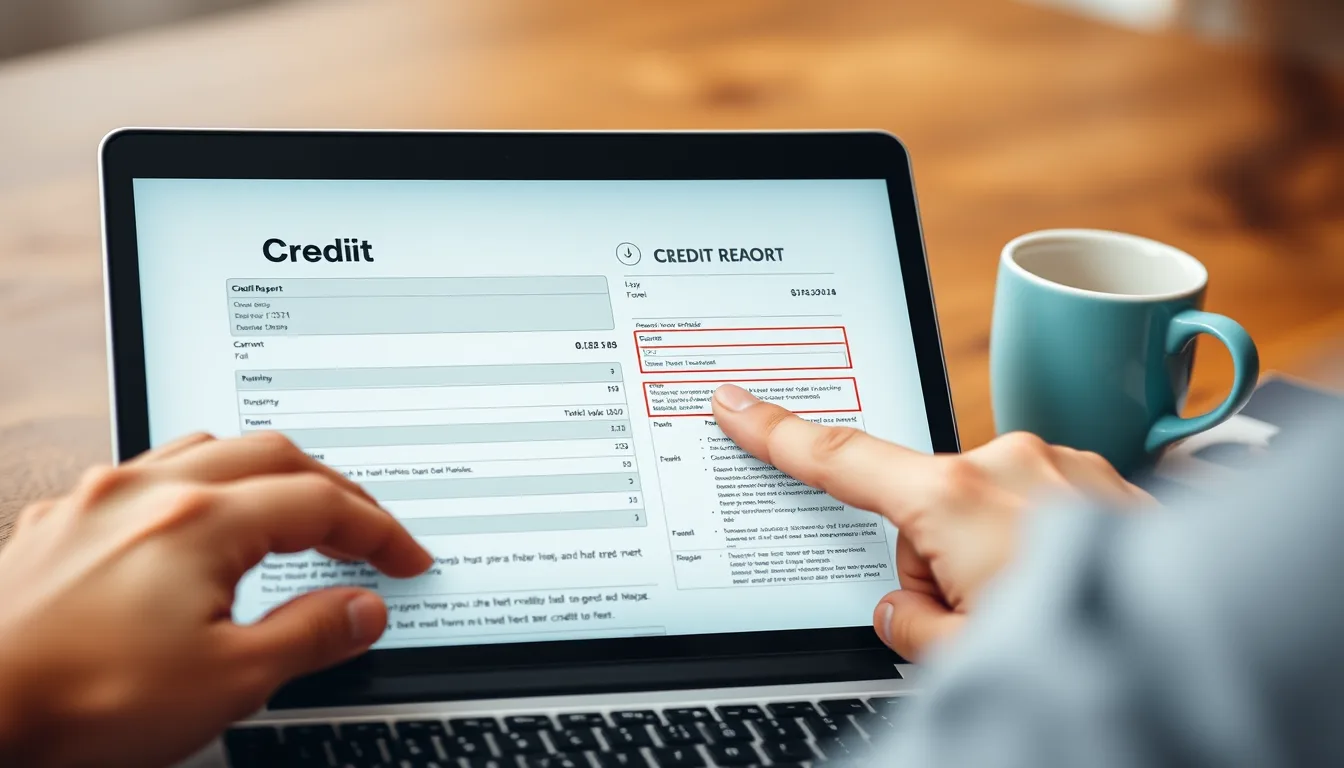
Reading a credit report isn't hard, but it does take a system. If you jump around randomly, you'll miss things. Work through the report in this order instead — it takes about 30 minutes and catches almost everything.
- Gather all three reports. Pull your Equifax, Experian, and TransUnion reports from AnnualCreditReport.com and save them as PDFs. You'll read them one at a time, but you'll compare them at the end.
- Start with personal information. Check your name, Social Security number, and every address listed. A wrong address or an unfamiliar name can mean a mixed file or identity theft.
- Skim the accounts list first. Before reading each account in detail, scan the section headers to get a feel for what's there — how many accounts, which ones are open, and which ones look like they don't belong to you.
- Read every account line by line. For each account, check the type (credit card, auto loan, mortgage), the opening date, the credit limit, and the current balance. The balance shown is what was reported on your last statement date, so it may be slightly behind.
- Look at the payment status field. This tells you whether the account is current. Watch for words like "late," "charge-off," or "collection." These are the entries that hurt your score the most.
- Check credit limits and utilization. Utilization is how much of your available credit you're using. If a card shows a $10,000 limit and a $9,500 balance, that's a red flag — high utilization drags your score down significantly.
- Find any collection accounts. For each collection, note the name of the collection agency, the original creditor, the amount, and the date of first delinquency. That date is important — it starts the clock on how long the collection can stay.
- Review the inquiries. List every hard inquiry and when it happened. Hard inquiries stay on your report for two years. If you see one you didn't apply for, that's a potential fraud warning sign.
- Write down every error on paper. Don't rely on memory. Make a list of anything that looks wrong — wrong balance, wrong late payment, account you never opened. You'll need this list for your dispute.
- Compare all three reports side by side. Accounts that appear on one bureau but not another aren't necessarily errors — many lenders only report to some bureaus. But large differences are worth investigating, especially if a collection shows up on only one report.
Give yourself permission to go slowly. The first time you do this, it's normal to feel overwhelmed. By the second report, you'll know exactly where to look.
Credit Report Codes and Statuses: A Quick Cheat Sheet
Credit reports are full of abbreviations that look like a secret language. They're simpler than they appear. Once you know the few codes that matter, you can read any account on the report.
Accounts are often labeled with a letter and a number, like R1 or I5. The letter stands for the type of account: R for revolving (credit cards), I for installment (loans with fixed payments), and O for open accounts (like charge cards). The number is a rating from 1 to 9: 1 means paid as agreed, and higher numbers mean progressively worse payment history.
| Term you'll see | What it actually means |
|---|---|
| Current | The account is being paid on time |
| Pays account as agreed | No late payments on record — this is the good zone |
| 30/60/90 days late | Payment was missed by that many days at the time of reporting |
| Charge-off | The original lender gave up on collecting after about 180 days of missed payments — the debt still exists |
| Collection | The debt was turned over to a third-party collection agency |
| Settled or paid settlement | You paid less than the full amount owed |
| Bankruptcy | A court process that discharges or restructures some debts |
Ratings below R1 or I1 aren't automatically permanent damage, but they do push your score lower. A single 30-day late mark can stay on your report for seven years, even after you catch up.
Also check the "date of first delinquency" for any negative account. That date determines when the entry is allowed to age off your report. If a collector re-ages an old debt by reporting a newer date, that's illegal — and it's a legitimate reason to dispute the entry.
How to Spot Errors and Signs of Identity Theft
Errors are far more common than most people assume. A 2021 study by Consumer Reports looked at one group of consumers and found that over a third of them had at least one error on their reports. You might have an old address lingering, a closed account still showing as open, or a balance that never updates.
These mistakes happen because data is entered by humans and moved between computers.
As you read, watch for these common errors: an account that isn't yours, a late payment you know you made on time, a wrong balance or credit limit, a closed account listed as open, and duplicate accounts. Each of these can lower your score even though you did nothing wrong.
Identity theft shows up differently. The classic signs are accounts you never opened, hard inquiries you never authorized, or collection accounts for debts you don't recognize. If you see any of those, don't panic — but do act quickly.
Contact the lender or collector, report it to the Federal Trade Commission, and place a fraud alert on your files.
When you spot an error, you have the right to dispute it. Under the Fair Credit Reporting Act, the credit bureaus must investigate your dispute — usually within 30 days — and remove anything they can't verify. If a data point is wrong, this is the cleanest, most reliable path to removing it.
For the full process, step by step, see our guide on how to dispute errors on your credit report.
One thing to remember: you can dispute directly with the bureau that shows the error, and you can also dispute with the business that supplied the information. Doing both often gets faster results. The key is to be specific and attach any supporting documents — the more proof you provide, the smoother the investigation goes.
What to Do When You Find a Collection on Your Credit Report
Seeing a collection on your report can feel like a punch to the stomach. Take a breath. You're not the first person to find one, and you're not stuck with it forever.
The first step is to figure out what you're actually looking at.
Ask three questions: Is the collection yours? Is the amount correct? Is the date of first delinquency correct?
A surprising number of collections fail at least one of these tests — especially the date, because collection agencies sometimes report the wrong starting point.
If you're wondering how to delete collections on your credit report quickly, the honest answer is that there's no magic button. But there is a process, and it works for a lot of people.
How to Remove Collections from Your Credit Report (When the Entry Is Wrong)
If the collection is inaccurate — wrong amount, wrong account, wrong date, or simply not yours — you have strong legal backing. Dispute the entry with each credit bureau that shows it, and let the collector know you're challenging the debt.
Under the Fair Debt Collection Practices Act, you have the right to request debt validation within 30 days of first contact. If the collector can't provide proof that the debt is yours and the amount is correct, they're required to stop collecting and tell the bureaus the debt is disputed. In practice, that often leads to removal.
For a complete breakdown of every method, read our full guide on how to remove collections from credit report. The short version: errors get removed through disputes, and validation requests give you leverage. Documentation is everything here — keep every letter and every receipt.
How to Get Rid of Collections on Your Credit Report That Are Accurate
If the collection is accurate, the rules change. You can't force a bureau to remove a correct entry, and anyone who promises to "delete" it in exchange for a fee is usually running a scam.
Your real options are negotiation and time. Some collection agencies will agree to remove the entry after you pay — this is called a "pay for delete" agreement — but you must get the promise in writing before you send any money. Others will settle for less than the full balance and report the account as paid.
You can also write a goodwill letter, where you explain the circumstances and politely ask the collection agency to remove the account as a courtesy. It's a long shot, but it costs nothing and occasionally works. The most reliable "removal" of all is simply waiting out the seven-year reporting period.
How to Remove Paid Collections from Your Credit Report
Here's a common misconception: paying a collection doesn't automatically delete it. The account will update to "paid," but the collection itself can stay visible for up to seven years from the original delinquency date. Paid is better than unpaid, but it isn't a clean slate.
The exception is negotiation. If you want the entry gone after you pay, make that part of the deal before you hand over a cent. Ask the collector to agree in writing to delete the account once it's paid.
Some will say yes, some won't — but you'll never know unless you ask.
And keep this in mind: even if the collector won't delete it, newer credit scoring models like FICO 9 and VantageScore 4 ignore paid collections entirely. Many lenders still use older models, but the trend is moving in your favor. Understanding the rules is the closest thing to a hack — when you know how to remove debt collection from your credit report the right way, you stop guessing and start acting.
You'll also see plenty of online advice about how to remove credit collections from your credit report with a single letter or a phone call. Ignore the hype. The real system runs on accuracy, documentation, and time — and that system is honestly better, because it gives you control.
How Long Do Collections Stay on Your Credit Report?
Collections stay on your credit report for seven years from the date of first delinquency — the date the original account first became seriously late. It's not seven years from the date the collection agency bought the debt, and not from the date you paid. That original delinquency date starts the clock.
This matters more than most people realize. A debt that went delinquent in 2019 should be gone by 2026, even if a collector has been re-reporting it every year. If you see an old collection lingering past the seven-year mark, it's outdated, and you can dispute it for removal based on the Fair Credit Reporting Act.
Bankruptcies are the one big exception, staying on your report for up to ten years. Most other negative items — late payments, charge-offs, collections — fall off after seven years.
Also worth knowing: if a debt is past the reporting window, it's also likely beyond the statute of limitations for being sued, depending on your state. That's a separate legal clock, but it's one more reason to check the dates carefully.
How Much Does a Collection Hurt Your Credit Score?
A collection is one of the most damaging items a credit report can hold. Scoring models treat it as a serious sign of risk, often far worse than a single late payment. As an illustration, analysts commonly say a single collection can cost anywhere from a few dozen points to more than one hundred points, depending on the rest of your file.
Someone with an otherwise clean history feels it the most.
The exact impact depends on the scoring model too. FICO 8, still the most widely used model, treats unpaid collections harshly and paid collections somewhat less so. FICO 9 ignores collections that are paid, and VantageScore 4 ignores both paid collections and medical collections under a certain size.
But "some lenders use a friendlier model" isn't the same as "your score is fine" — many lenders still rely on the harsher versions.
The good news is that score damage fades with time and good habits. As the collection ages, its impact slowly lessens, especially if you're paying everything else on time. Keep your card balances low, keep old accounts open, and avoid new hard inquiries while the collection is still recent.
And if the collection is a mistake? Dispute it, get it removed, and the score impact goes with it. That's the single fastest way to improve your score — not a new credit product, not a paid service, just removing an error that should never have been there in the first place.
Credit Report vs. Credit Score: Why They're Different
Again, the report is the full record; the score is the summary. Your report can be forty pages of detailed history, while your score is just a number from 300 to 850. That number is what most lenders use to make quick decisions, but it's always calculated from the underlying report data.
There isn't just one credit score. FICO and VantageScore are the two big scoring companies, and each has multiple versions. Your bank might use FICO 8, an auto lender might use FICO Auto Score, and a landlord might use VantageScore 4.
That's why the "free score" from a random website can differ wildly from the score a lender sees.
What goes into the score? For the most widely used FICO models, the breakdown is roughly: payment history at 35%, amounts owed at 30%, length of credit history at 15%, new credit at 10%, and credit mix at 10%. So the report items that matter most are your payment statuses and your balances — exactly the two things you check while reading.
One relief: checking your own report or your own score is a soft inquiry, which never hurts your score. Pull your reports as often as you need to without worrying about damage.
How Often Should You Check Your Credit Report?
At minimum, once a year. That's the original federal standard, and it's enough for a person with a stable history who isn't applying for anything new.
But you have better options now. Since the free weekly program began, there's no real reason to wait twelve months. A quick monthly check takes ten minutes and helps you catch problems early — before a fraudulent account sits on your file for a year.
The Consumer Financial Protection Bureau recommends reviewing your reports for errors on a regular basis, especially before a major purchase like a home or car.
You should also check any time you're about to apply for a mortgage, auto loan, or rental. A pre-check gives you time to dispute errors before the lender sees them. If you've been a victim of identity theft, checking monthly is almost mandatory for the first year or two.
Set a calendar reminder. Put it next to your bill-pay day, your birthday, or any regular date you won't forget. Thirty minutes, three reports, one clear picture of where you stand.
Common Mistakes to Avoid When Reading Your Credit Report
Most people make the same handful of mistakes the first time they read their report. Knowing them in advance saves you the trouble.
- Mistaking the report for the score. The report has no score built in. You're checking data, not a number.
- Only pulling one bureau's report. Since lenders report unevenly, one bureau may look clean while another carries an error.
- Skipping the personal information section. A mixed file with someone else's address can cause bigger problems than a wrong balance.
- Ignoring old closed accounts. They still contain status data that can be wrong, and errors there deserve a dispute too.
- Confusing hard and soft inquiries. Only hard inquiries from credit applications can lower your score.
- Paying a collector without getting promises in writing. If "delete for payment" isn't written down, it doesn't exist.
- Hiring a credit repair company for work you can do free. You have the same legal rights they do — and they can't do anything you can't do yourself.
None of these mistakes are catastrophic, and they're all avoidable. The fact that you're reading this guide already puts you ahead of most people.
Frequently Asked Questions About Reading Credit Reports
How long does a collection stay on your credit report?
Most collections stay for seven years from the date the original account first went delinquent — not from when the collection agency bought the debt. Paying it off doesn't erase it before that window closes, though paid collections generally look better to lenders, and some newer scoring models ignore them entirely. Bankruptcies are the exception, staying for up to ten years.
Can I remove a paid collection from my credit report early?
Not by right, no. Credit bureaus are only required to remove information that's inaccurate, outdated, or unverifiable. That said, some collection agencies will delete a paid collection if you negotiate it in writing before you pay — commonly called a "pay for delete" agreement.
They're not obligated to agree, so get any promise in writing first.
Why do my three credit reports show different information?
Because lenders aren't required to report to every bureau. One credit card might report to Experian, while your auto loan reports to Equifax and TransUnion. That's why your reports can genuinely differ, and why checking only one bureau can leave you with an incomplete picture.
What's the difference between a hard inquiry and a soft inquiry?
A hard inquiry happens when you apply for credit and a lender pulls your report. It can lower your score slightly and stays on your report for two years. A soft inquiry — checking your own report, pre-approved offers, or employment checks — never hurts your score, which means you can check your own credit as often as you like.
Do collections still hurt your score after you pay them?
They can. The collection remains on your report as "paid" for up to seven years, and an unpaid collection generally hurts more than a paid one. Newer models like FICO 9 and VantageScore 4 ignore paid collections, but many lenders still use older models that don't.
Paying is still the right move in most cases — it prevents the balance from growing and looks better to future lenders.
Key takeaways
Reading a credit report isn't a secret skill. It's a simple process of checking sections, verifying details, and writing down anything that looks wrong. Do it with all three bureaus, and you'll have the clearest possible picture of your credit.
- Pull all three reports free from AnnualCreditReport.com — you're entitled to them, and you can do it weekly through at least December 2026.
- Read every section: personal info, accounts, collections, and inquiries. The account statuses and balances matter most for your score.
- Errors are common, and you have the legal right to dispute them. The bureaus must investigate within about 30 days.
- Collections stay for seven years from the original delinquency date. Paying doesn't automatically delete them, but you can negotiate removal in writing.
- Skip the paid repair services. Everything they do, you can do yourself with a little patience and documentation.
Remember, this article is general information, not financial advice. If your situation feels overwhelming, a nonprofit credit counselor can look at your whole picture at little or no cost. You don't have to figure this out alone — and you don't have to fix everything in one sitting.
Start with one report, one section, one error. That's how progress begins.
Frequently asked questions
How long does a collection stay on your credit report?
Can I remove a paid collection from my credit report early?
Why do my three credit reports show different information?
What's the difference between a hard inquiry and a soft inquiry?
Do collections still hurt your score after you pay them?
This article is for general informational purposes only and does not constitute financial, legal or credit-repair advice. Always consult a qualified financial advisor or credit counselor about your specific circumstances.

Written & reviewed by
Can OTUEditor
Can OTU is the editor of this site, curating and reviewing every guide for accuracy and clarity.
View all guides →